I was reading a few pages in Paradise Lost the other day, and I came across the word Belial. As cited in Milton’s work, this is Hebrew for “worthlessness” or “vanity.” That puzzled me at first. I’ve always thought of vanity as the opposite of worthlessness. I mean, how can you be vain if you feel worthless?

After some quick research, references to vanity appear often in the Bible, and the word has a variety of meanings such as meaninglessness, wickedness, falseness, idolatry, worthlessness and futility. The way we typically use this word today to mean “boastful” is actually not that common in the Bible. That just happens to be the default definition of vanity as I know it.

And then it was clear to me. Vanity (meaning boastfulness) many times is a symptom of self-doubt and low esteem. It’s almost like vanity is the act of trying to convince oneself and others that he or she actually is valuable. I’ve mentioned before that self-esteem has been a bit of a problem area for me throughout my life. It sometimes causes me to over-analyze my actions, to focus too much on me, to actually become vain or self-centered. It’s ironic. We who doubt our worth the most, become the most self-obsessed. Vanity and worthlessness. Not that far apart after all.

I’m being honest here, right? I mean, I’m speaking the truth about the journey I’m on, good, bad, ugly, indifferent. Right? Well, I’m frustrated. After some positive movement, I feel like I’ve veered off the course. I haven’t been able to write and have allowed a host of excuses prevent me from posting lately. I haven’t been hearing from God. My blade is dull. My walk is at a stand still.

And what I’ve noticed about the walk, the journey, is that you aren’t moving across flat land. You are climbing a mountain. Momentum is important. Constant motion is important. When I say I’m at a stand still, that’s actually an overstatement. Once you lose steam, you lose ground. So if you aren’t making progress, if you aren’t moving forward, you are actually sliding backward. There is only drive or reverse. There is no neutral. There is no park. You are either marching closer to God or wandering farther from Him. That’s my point of view anyway.

The physics aren’t in my favor. It’s much easier just to roll down the side of a mountain than to dig in and climb. And the farther up the mountain I go, the harder it gets to maintain the climb, to reach the next level. But if I stop, if I fail to maintain momentum, the fall from there is much higher, must faster.

Of course, we all are going to lose steam at points in our journeys, lose ground, fall backward. The key is to recognize you are headed in reverse and recover lost ground as quickly as you can. If we think of being stuck or stagnant only as failure to move forward instead of actively moving backward, we probably won’t act with the same sense of urgency. I know I haven’t. Right now, again if I’m being honest, I’m going in reverse. And I fully recognize it. I’m trying to get things turned around quickly. It’s not the first time I’ve been here. Won’t be the last. My ongoing goal is to make it higher up the mountain each time, and when I fall, to fall a shorter distance. After all, no one’s journey can be depicted by a perfectly straight line. Instead, they look like stair steps and scribbles up and down. As if charting the stock market. Our walks are highly volatile.

I have a remarkably shallow pool of physics knowledge to wade in, but I do know that an object in motion tends to stay in motion with the same speed and in the same direction unless acted upon by a sum of physical forces. Right now, physical forces (me) AND natural forces (the mountain) are acting upon my motion.  The third law of gravity says for every action, there is a reaction. (And that, my friends, was the last splash of water in the pool.) So, it’s my turn again to react to my situation. I can either roll all the way down, or dig back in and claw. I choose to claw.

This blog is mostly about my walk with God, my journey toward a deeper relationship with Him. Today, I’m pausing to spend a few moments on a soapbox.

According to the most recent Harris Poll, only 26 percent of Americans think they will have bodies in Heaven. I ask you, what in the world does that have to do with anything? I mean, really, is it important or relevant whether we have bodies in Heaven or whether the majority of us believe we’ll have bodies in Heaven? This was just one of several things in a recent Newsweek article that rubbed me the wrong way. Here’s the link. So read it and tell me what you think. 

http://www.newsweek.com/id/235418?GT1=43002

Evidently, Newsweek staffer Lisa Miller has a new book out called Heaven: Our Enduring Fascination With the Afterlife. In her article, which promoted her book (different issue for another day), Miller also quotes research showing that the number of Americans who believe in the resurrection is down 10 points to 70 percent, while those who believe in reincarnation is on the rise at 30 percent.  She states that 21 percent of Christians believe in reincarnation.  

Miller also says, “Resurrection may be unbelievable, but belief in a traditional heaven requires it.”

Really? Resurrection is unbelievable. But Heaven is totally explainable and rational and as easy to prove as saying the sky is blue? Resurrection. Reincarnation. Heaven. Any belief you have in a higher being. You can’t prove ANY of it. None of it is “believable” in terms of the reality we all live in day-to-day. Later in her article, Miller discounts those who fall back on the “intellectual flabbiness” of the “theological cop-out” that says “We cannot know what God has in store for us.” If we could solve for Heaven and the afterlife with a mathematical equation or a scientific explanation, we wouldn’t need faith, now would we? I’m not sure why people feel the need to assault specific elements of the Christian story when the entire point of any religion is faith. Not empirical knowledge or undisputed fact.

Hard to say why this wound me so tightly, but I must say that I got fired up after reading this article.  Given this reaction, you probably think I’m going to ask you not to buy this book. On the contrary. I’ll likely buy it myself. I’m curious to more deeply understand where she’s coming from and exactly what view she’s promoting. I could be jumping to conclusions. Not likely, based on the article. But possible. 

So, anyway, the number of Americans who truly believe is on the decline. That much seems to be a mathematical certainty based on the research. It wouldn’t hurt for us to stop and ask why. I think it is very important as Christians to delve into the cause and effect there. Meanwhile, I have no interest or curiosity around the whole body in Heaven thing. And I have no patience for people who want to propose that the resurrection is unbelievable. If you want to challenge something, step up and challenge the idea of God Himself. Take that one on. Because if it’s no great stretch to believe in a Higher Being who created the world from scratch, how is it so “unbelievable” that He could send his Son to earth and raise Him from the dead? As for not knowing what God has for us. Yes, this is true. TRUE. Not flabby logic or a cop out. And as Christians, it is a fact we have to embrace and accept. We don’t know exactly what lies ahead. But once again, if we did, faith would not be the necessity that it is.

So there you go. Soapbox over and out. Back to the journey. And in case I don’t post again between now and then…Happy Easter to all!

I hate nothing more than running late. If I show up late to an event or an appointment or even to hang out with friends, it irks me. I get stressed. I drive aggressively. My blood pressure rises. I all but come unwound. And with life moving as fast as it does, we all have lots of opportunities to feel this way. Every day brings with it a rush of activities, all compacted into the 18 hours when we aren’t sleeping. Most of my day is an attempt not to run behind schedule.

What’s even more troubling is when I’m running late for something that I might miss altogether. Like a plane or bus. Previews at the movies (look, I want to get my 20 bucks worth). Or when I’m running late for something that might be uncomfortable. Like church or a wedding or a big meeting. (you know, anything where you risk the awkward walk of shame). I get that sick feeling in my stomach, overactive butterflies or when you go too high on a swing. It can really damage the nerves.

I guess that’s why I get so agitated about my spiritual walk. A long time ago, God told me that I wasn’t ready. And ever since then, I think I’ve probably been rushing around like I was late for a date or a job interview. I’ve assumed that I was behind schedule, that I was holding up God’s plan, that I was risking it all and might miss it altogether.

But then, I came across this verse: 

Psalm 27:14 – Wait on the Lord; Be of good courage, and He shall strengthen your heart; Wait I say, on the Lord!

God moves in His own time. He has His own schedule. And when He told me I wasn’t ready, it wasn’t to spur me into warp speed. He just wanted me to know that I needed to be patient. He wasn’t ready either. Think of that. God hasn’t been ready. Now, this is a chicken and egg scenario, like a lot of things. Is it because He knows I’m not ready that He’s not ready? I’ll try not to bend my mind out of shape and instead remind myself what many people have told me throughout the years. God does things in His own time. He answers prayers, works miracles, moves mountains, all in His time.

Meanwhile, I’ve been pushing myself, looking in the mirror, questioning the reflection, “What are you waiting for?” Turns out maybe I’m waiting for God’s timing and just need to focus on doing what I need to do to be ready when He gives me the signal.

My favorite part about this verse is the very end. There is an exclamation point. Wait I say, on the Lord! For me, this means two things. 1. Don’t go Mel Gibson on the situation (Lethal Weapon anyone?), charging ahead on your own because you can’t be patient. 2. You may have to be really patient. It’s not wait, it’s WAIT. It may be a while. It may feel like a very long time. It will be worth it.  

And so…I wait.

One of the most helpful strategies for me in my journey has been to take a closer look at myself. In continuously diagnosing where I am, I increase the likelihood of reaching where I want to go. After all, the most important key to solving a problem is accurately defining it. Most of us are not naturally self-aware. Myself included.   

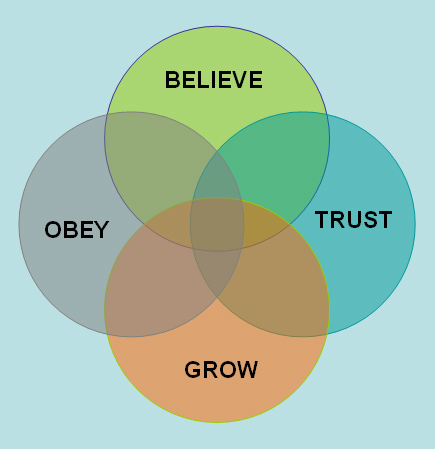
I recently found a passage and a parable that has not only helped me as a diagnostic tool but also provided me with a model for more effectively approaching my faith walk. Luke 8: 11-15 talks about seeds scattered, some falling by the wayside, others on the rock, others among thorns and finally those landing on good ground.  The parable goes on to describe what happens to each group of seeds. I’ve adapted it below to put it in categories that work better for me, using descriptors that are emblematic of our most common challenges as Christians. It’s important to note that three of the four categories are negative. It’s also important to note that you can find yourself in more than one at a time, although I’d bet that you can always identify more strongly with a single category.

Walls – Like the wayward seeds, you have heard the word but it has been quickly taken from you, and you don’t believe. You’ve built walls of doubt. You are cynical about God and skeptical about what He can do for you. Maybe you even question the very existence of God. Either way, you lack the belief necessary to progress in a relationship with God.

Chains – Like the seeds that fell on the rock, you have no roots and temptation quickly causes you to fall away. You are owned by sin, consumed, trapped, unable to exert self-control. You fall into the same snares over and again. You feel like you can’t overcome human nature.

Idols – Like the seeds that fell among the thorns, you are choked with cares, riches and pleasures of life. You likely have your priorities out of whack. You consistently experience fear, worry, stress. You are trusting in yourself instead of God. Focusing on things that expire instead of things that are eternal.

Fruits – Like the seeds that fell on good ground, you are producing. You are patiently progressing toward a deeper relationship with God. You have momentum. You are on a journey.

So where do you fit?

If you find yourself stuck behind walls, your main struggle is with your ability to believe. In your mind and your heart, you have to buy in to the salvation story, to the promises God has made. You might have to find ways to come to grips with doubts you have or internal struggles which prevent you from believing. If you are bound by chains, your fight involves obedience. You are failing to follow God’s instructions for your life. You have to gain small victories in resisting sin and build from there. Those in the idol category are misplacing their faith and trust, finding purpose in worldly things, relying on things other than God to sustain them. And finally, those of you fortunate enough to find yourself in the fruits category are experiencing growth, making progress in your pursuit of God.

This model, or framework, helps me organize my approach to growing with God. It also ties directly to my earlier post (You Are Not Alone), where I discussed 2 Peter 1:5. I believe as you progress in this model, you begin to outwardly display the attributes from that passage. Faith. Virtue. Knowledge. Self-Control. Perseverance. Godliness. Brotherly Kindness. And finally, Love. If you are able to more completely believe in the promises of God, trust Him and pursue him above all else, resist temptation and be obedient, then you will grow, your roots will deepen, and you will produce much fruit.

Give privately. Receive publicly. I don’t know about you, but I could not be more backwards about this if I tried.

We do our real business with God in the backroom. We unpack our bags and get real. With no witnesses. No one to see the grace and the mercy and the impact. In public, we suit up and serve. We make grand gestures. We make sure to be seen sowing. Actually, I should use the pronoun “I” and let others decide whether this fits them as well. Sorry to project.  

A while back I heard a sermon on giving in which the presenter emphasized that we are called to give anonymously. That we should not draw attention to ourselves in service. (Give privately)

Meanwhile, I’ve seen people with very public struggles who have not only turned their lives around but also positively influenced others in the process and served as glowing endorsements of what our God is all about. (Receive publicly)

There is a parable in Luke 8:26-39 about a man possessed by demons. He approaches Jesus in a crowd, desperate to be healed. Jesus obliges, driving the demons out of him and into a herd of swine who run downhill into a pond and drown.

A few interesting things about this story (other than pigs running downhill into a pond to drown). 1. His plea for help was a public one. (As is the case in many parables like this one). 2. The people who witnessed the feat were also greatly impacted. They immediately ran to tell others what they had seen. 3. The people they told came to see for themselves, but they reacted with fear, and that fear was contagious. The entire region asked Jesus to leave because of this fear. 4. Jesus responded by instructing the man to go back to his home and tell of the miracle. He did so, proclaiming to the whole city what Jesus had done.

Quick question. What if he had approached Jesus in private, one on one with no witnesses? And what if he then kept the miracle of his healing to himself and didn’t share it with the world?

I believe there are two basic challenges that heavily contribute to the flip-flop that I’ve been experiencing.

The first challenge I see is that most churches emphasize service at the expense of personal growth. When the main statistic to judge success is the number of “professions of faith” then I think we miss a big, big part of it. Is it important to reach more people with the Gospel and to lead more people to Christ? Is it important to serve and to give and to do good? I’d have a hard time saying no, obviously. But what I’ve come to realize more deeply is that our primary purpose on this earth is to be in relationship with God, to honor and worship Him, to simply be with Him. The rest of His plan will unfold from there. But it is easy for us to experience guilt when we feel compelled to spend time working on ourselves. Sorry, I’m doing it again. It’s easy for “me” to experience guilt.

The second challenge I see is that most Christians are like me. They are driving in reverse. Receiving privately. Giving publicly. They get overly concerned about damaging their witness, and forsake opportunities to be real, open, transparent and yes, flawed, when interacting with others. They seek redemption in the privacy of their own homes, but stand tall in public, demonstrating the good they are contributing. The best role models are not beautiful. They are broken. Just like the man with the demons inside, the power lies in witnessing the grace and goodness of God.

No wonder fear is such a common emotion for us,  just like the people in the parable. When we see this in action, or think about doing it ourselves, we freak out. We are afraid. We don’t know how to respond. It’s just too weird and uncomfortable. This man, and his approach, should be the rule, not the exception. 

I will be honest. This is one of the biggest struggles I have. It scares me to death to put my flaws out on display, to truly open up and be me (good, bad, ugly). So, I’ll be up front and say that I am definitely not practicing what I’m preaching. Yet. But that doesn’t mean I don’t get it. I do.  So now all I need is a herd of pigs, a pond and a little bravery.

Last night, I had the pleasure of doing one of my least three favorite things: attending a wedding. It’s not that I have anything against the institution or anything. It’s just that suit + strangers = a very uncomfortable situation for me. And that’s before you get to the reception where you mix in dancing with strangers (sounds like a great new reality show).

This wedding was rather painless as weddings go. Nice, short ceremony. Good food. Interesting people. And I even let my wife drag me to the dance floor for a few songs.  Back to the interesting people. At our table, we had a young couple from San Francisco, a couple who recently moved back to Nashville and were expecting their first child in a few months, and a martial arts expert who spent the last 15 years training young men for special forces assignments. He formerly was the one accepting special forces assignments, going on covert, top-secret, high-danger missions across the globe. I sized him up, fascinated that I had the exact same size and build as this Chuck Norris character. As he talked about some recent cage matches he had attended (seriously, cage matches), I joked that I would last about 20 seconds in a cage (depending on how long it took the other guy to catch me). He responded very matter of factly by telling me it’s just all about training, like everything else.

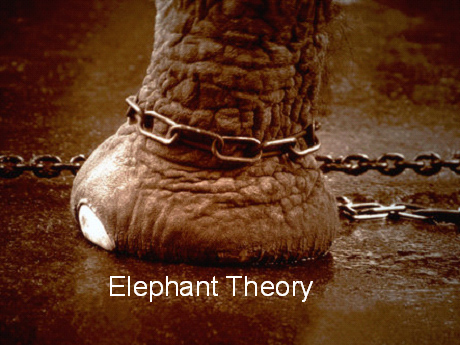
Later, as the conversation continued, he posed a question. “Why do you think that elephants at the circus can be restrained with just a small chain on their leg? Don’t you think they could break that very easily?” He went on to explain what  he called “the elephant theory.” I feel like I’ve heard this before, and assume that anyone reading this likely has as well. But combining his brief explanation with a quick and dirty Google search, here it is.  

Supposedly, when an elephant is young, a chain is placed around its leg, the other end fastened to the trunk of a tree.  After several attempts to wander past the boundary imposed by the chain, the elephant realizes it can’t break free and so it adjusts accordingly. When fully grown, the same elephant can be restrained by the same chain, despite the fact that it could easily rip it apart, because it has been programmed to believe the chain is too strong. Resistance is futile. The chain wins.
As I was sitting down to write my blog post for today, the following analogy came flying right at me, so thank you Chuck Norris. I have no doubt it has been used in countless sermons. I am under no delusion that I am the first to successfully map “elephant theory” back to a spiritual truth. But God did share it with me, so I’m paying it forward.

A struggle I have is that I feel like I’ve been programmed, unintentionally, to be chained by sin. At an early, impressionable age, we all learn that we are not worthy of salvation, that it is by grace we are saved, not through works. Please understand, I believe that to be true, 100 percent true, but I also believe that many of us are set up for failure in our walk because we hear “you can’t overcome sin on your own” but internalize “you can’t overcome sin.” Uh oh, just missed a few important words on the end of the transmission. Two big words.

Even if we get it right in translation, this truth is what chains us when we drift from God.  I wrote earlier about idols, meaning things we rank in front of God, and how they impose an utter lack of prioritization. Here we are talking about chains, the self-imposed challenges we place, building on the idols in our lives with a complete lack of trust in God. We’ve been trained that we can’t overcome the tiny chains of sin. And we don’t trust that God will provide. So we are leaving it up to ourselves, and we know we can’t win.

What is the outcome of this madness going to be? A powerful elephant that could be demonstrating its strength is instead led around by a small chain for the world to witness its weakness.

It’s not just that we do a bad job of internalizing the teachings and trusting in God. We also are all human, and have all made mistakes. And just like elephants, we have long memories. It’s funny, I sometimes leave the living room and forget what I needed before I get to the kitchen, but I never forget for one second any significant transgression or failure that I’ve had in my time on this planet. Whether they be spiritual struggles or otherwise. By holding on to these past transgressions, even the ones we’ve served up to God, we create chains. We tie ourselves down. We place ourselves in bondage. We accept future limitations based on past truths. We don’t for a second stop to think that we might be stronger now, or that we could grow stronger. We are defined by a past we can’t forget. We can’t run because of chains, despite the fact that we could shed them fairly easily.

It is a very effective tactic for Satan to use against us. He takes a truth about us not being worthy, and then uses that deeply seeded belief in unnatural ways to construct  a chain that says because of this, we can’t successfully overcome sin. Because of this, we have failed and will fail again. Because of this, we also aren’t worthy to pursue God, to be in community with God, to have a deep relationship with Him, to contribute to His Kingdom. I don’t think many of us consciously think like this, but it’s the internal hopeless feeling that many of us have about our current situation where this comes into play. We haven’t fully trusted God, and we’ve failed on our own, so we just pace in circles around a tree, accepting the limitations imposed on us by our selves and our surroundings. You’ve heard it. You’ve said it. “I can’t change this. I can’t do anything about this.”

Oh yes you can. And you can start by forgetting what isn’t possible in the first place.

Philippians 3:13-14 No, dear brothers and sisters, I am still not all I should be, but I am focusing all my energies on this one thing: Forgetting the past and looking forward to what lies ahead, I strain to reach the end of the race and receive the prize for which God, through Christ Jesus, is calling us up to heaven.

Once again, thank you Chuck Norris. I am in training, and have been in training for a while now, preparing for my own cage match. This training will equip me to overcome any physical, mental or spiritual limitations of mine that would give an advantage to my enemy. I can’t wait until I get my mind right, forget the preconceived notions built by the past, rip this chain off my leg and start running to freedom. Care to join me?

File this one under “everything happens for a reason.”  Or maybe “can’t see the forest for the trees.”

Everyone would be well served by gaining some perspective. I got mine this week, when I realized that possibly the greatest frustration, the biggest disappointment, the most painful thing in my life right now, has actually been given to me for a specific purpose. It was given to me to provide perspective, to help show me something I needed to deeply understand about myself, to force me into a choice between trusting God with it or digging a deeper hole and wallowing in it. I’ve stressed and obsessed about it for a couple of years now, seeing it only as a burden and an unfortunate reality I had to accept.

But after stepping back for a moment and looking at it with a fresh eye, it is incredibly clear to me that I have been foolishly passing over an incredible learning experience and growth opportunity. It doesn’t mean that this inconvenience in my life is any less inconvenient, but it does mean that it has a clear purpose and has presented me with a deeper understanding of myself, and of my relationship with God.  How cruel that I would be pressed with a challenge that directly struck at a major weakness I have long endured. Or how clever. By learning how to deal with the challenge at hand in the right way, I will strengthen myself and my walk. It doesn’t make it any easier to deal with or make it stink any less, but it does help me respond more positively to it.

To gain perspective, you must be good at reading signs, and signs are everywhere. This world is full of them. In an earlier post I talked about changing your filter so that you could better view the world around you. I have another simple, yet effective tip for you and me today that can help us gain perspective. Ask why. My five-year-old is great at it. We’re having pancakes for breakfast. Why? Daddy has to go to work. Why? Time for bed. Why? No, we can’t go to Disney World tonight. Why? The sky is blue.

Why? Why? Why?

If we were to practice firing off this three-letter word on a regular basis, we would force ourselves to ponder the world around us, the endless string of things that happen to us on a daily basis, the signs we are passing by, over, through, around. We would continuously analyze and interpret. We would find perspective. We would see more forest, and fewer trees. We would be more likely to remove ourselves from the muck and mire of the scenario to snap a clearer picture.

So, the next time you find yourself in the midst of a trial or an unpleasant situation, ask yourself what God has for you in this moment of difficulty. Chances are, there is a reason for which this is happening. You just have to ask why.

Repetition. Get the vibe of this post yet. Repetition. It’s about the power of…repetition.

Take Psalm 107 for instance.

Some wandered in desert wastelands, hungry and thirsty, their lives wasting away.

Verse 6: Then they cried out for the Lord in their trouble, and he delivered them from their distress. 

Some sat in darkness and the deepest gloom, as prisoners, because they rebelled against the words of God and despised His counsel.

Verse 13: Then they cried out for the Lord in their trouble, and he delivered them from their distress. 

Others saw the works of God on the seas, but in their peril their courage melted away, and they reeled and staggered like drunken men.

Verse 28: Then they cried out for the Lord in their trouble, and he delivered them from their distress. 

Getting the picture? Whether you are lost, rebellious or weak, it’s the same outcome. Cry out in trouble, and be delivered. Again, and again. Repetition.

2 Peter 1:12 – So I will always remind you of these things, even though you know them and are firmly established in the truth you now have. I think it is right to refresh your memory as long as I live in the tent of this body.”

For all of the adult learners out there, we need to hear things more than once. We need them reinforced so that our muscle memory responds correctly when we really need it.  It’s important that we meditate on what we know to be true, and that we continue to revisit in the name of remembering.  It isn’t really memorization as much as it is keeping our minds sharp. Otherwise, we’re very likely to forget a lot of basic things that can come in quite handy.

The other nice thing about repetition is that is provides consistency and predictability. Security, if you will. It’s great that God is unwavering, that with complete accuracy you can predict His response. What if others could say the same about us and how we respond to the world around us?

I was saved at the age of 11, during Vacation Bible School. The pastor finally spoke in words I could understand, using the game of baseball as an analogy for salvation. It still took my cousin wandering down the aisle before I was brave enough to do so myself, but on that day, I became a Christ follower. Finally, my grandmother could put her hand down. You see, every Sunday, the pastor would ask for unspoken prayer requests, and she would raise her hand. Later on, I realized, I was the unspoken request that was burdening her. But I digress.

And with that public profession of faith, I fell into a lifelong trap that sidetracks many Christians. I thought I should immediately be transformed, with a new heart and a new mind, membership in the club being all I needed to be whole. Born again after all.

Some quarter of a century later, this is still one of the main reasons why I find it so hard to deepen my relationship with God. Why many of us, I will assume, still struggle with that. We have the equation all wrong. Salvation = Faith = Mission Completed.  The church actually does talk about deepening your relationship with God, but for some reason it has always felt to me like it overly emphasized the transformation that occurs when you accept Christ, making it a divine transaction instead of the beginning of a deeper journey.

2 Peter 1:5 – For this very reason, make every effort to add to your faith goodness; and to goodness, knowledge; and to knowledge, self-control; and to self-control, perseverance; and to perseverance, godliness; and to godliness, brotherly  kindness; and to brotherly kindness, love.

Wow, that passage displays a process with many steps that we tend to either skip over or take on all at once.  It is no wonder we burn out before we catch fire for God. We try to bite off a big chunk of godliness, for instance, before we spend time gathering knowledge and learning self-control. I’m not suggesting this is a process that must absolutely require a set amount of time. In fact, I’m sure that some people move through the steps more quickly than others. I am saying that the order is important. How can you consistently dismiss sin and persevere if you haven’t gained an understanding of what it takes for you to build self-control? From faith, it all builds. Faith grows stronger along the way. But from faith, you must build.

I must say that again in my 25 years of Christianity, it wasn’t until this week that I had this level of clarity about where I’d been going wrong in earlier attempts to walk with God.  Partly because I was just not being aware or open to hearing from God. Partly because when we gather together corporately as Christians, we don’t always create an environment conducive for growth.

Everyone shows up with their Sunday best on, and by appearance and attitude we create an illusion that all is well on our peaceful walk with God. We’ve been transformed, and we are whole. Mission completed. In the meantime, we create the belief that if you are struggling with faith or dealing with sin or drifting from God that you are all alone. A misfit in some way. You just don’t get it.

Occasionally, we see the courageous comeback story of someone who has rebounded from drugs or alcohol or overcome abuse or tragedy. Call me a pessimist but these stories, while inspiring, usually leave me feeling more alone in my struggle because in addition to these stories being positioned as exceptions to the rule, they also are usually examples of people who are actually back on track. So for those still in the midst of a relationship crisis, the message can be that indeed we are alone. There were a few people out there like us. But now they are back in the game as well. It might just be me, but after several recent conversations, I don’t believe that to be true. And while deep down we know that “all have sinned and fall short of the glory of God,” it doesn’t stop our imagination from placing us on a deserted island.

It’s a viscous cycle. The reason for creating the illusion is because most of us are afraid to be real and open up.  And because of this fear, we perpetuate the fear in others that they are alone in their struggles, making their problems seem bigger and badder and that they have failed because everyone else seems to be doing just fine. It also creates the belief that those of us who aren’t where we want to be can’t offer any value because of our flaws. How quickly we forget the achievements of men like the disciples, who were riddled with shortcomings and weakness but did great things despite them.

If we would all pause and remember that it is the pursuit of being Christ-like, not actually achieving it in full, we would be in a better place. We might not be so afraid to let the world in and see that we don’t have it figured out. We wouldn’t unintentionally alienate others who really need support but aren’t comfortable being “the only broken ones.” In protecting and guarding ourselves, or putting on a mask because of pride, we perpetuate a collective aloneness.

I’ve also struggled with a seemingly widespread tendency of Christians to mistake holding people accountable with judging them. We’ve all done it, and we’ve all had it done to us.  I see it all the time. People who are strong in their faith and well-intentioned but then write someone off or place a black mark next to their name in the spirit of “holding them accountable” when really, they are judging them for not being transformed and whole.  It is not our place to forgive when there isn’t an act that directly impacts us. People don’t need to be judged. They don’t need to come to a place of worship or a community of believers and have to consciously monitor and censor themselves out of fear that someone will render a verdict and condemn them as spiritual criminals or deviants. Usually if I am tempted to judge someone, it is because I need to feel better about where I am and what I’m dealing with. It’s the only way I have of telling myself that I’m not so far off the mark after all, that I’m not alone. 

Considering all this, I’m going to take the same stand as one of my very good friends, who just the other day told me that he refused to live in fear any longer. Amen! This can be done by me being fully aware of where I stand in the process. For me, that means the knowledge phase. Next up, self-control. It also means that I have to continually remind myself that just like public speaking, most everyone is uncomfortable with where they are in their walk with God. I am not alone. And neither are you.

Areas of Interest

Past Stops on the Journey

Enter your email address to subscribe to this blog and receive notifications of new posts by email.

Join 21 other subscribers

Top Posts