Thanks to all of you who recently helped out by taking my survey on spiritual growth. I was able to get a good number of surveys completed, but still would love to get more responses. Here’s the link if you know anyone who would like to fill it out: http://www.surveymonkey.com/s/6FLGQTJ

Over the next few days, I’ll be sharing the initial findings via the blog, starting with this post. I’ll wrap things up by telling you why I fielded the survey in the first place. Stay tuned.

According to the early findings, most of us seem to be suffering from a light switch relationship with God. On. Off. On. Off.

The majority of survey respondents said they were not content with their current spiritual walk.  Sixty-six percent of  those people said they were “On again, off again. There have been times when they felt close to God, and times when He seems very far away.”

Most reported they had the knowledge and support they needed to pursue a deeper relationship with God, and only a few stated they didn’t know where to start  in terms of getting closer to God.

The most common reasons given for not successfully building a relationship with God were staying motivated and struggling with competing priorities. I’m sure in many cases, those can be closely linked.

Nearly half of the people surveyed said they needed a lot of help or all the help they could get in the areas of: Purpose, Wounds & Trials, Prayer, Witnessing

People believe they need the most help in the witnessing department and the least help in worshiping.

So far, the demographics of the responses have skewed slightly towards male, and are highly concentrated in the age range of 25-44. Most reported accepting Christ as a child.

I am still pulling my conclusions together on what I think the results really show. Interested in your thoughts on these results as well. Initially, I find it telling that so many of us (myself included) struggle with sustaining momentum in our walks. My experience over the last few years has played that out very well.

A lot of what I’ve learned about myself and my faith has revealed major drivers that perpetuate the on again off again rhythm that is so easy for me (and I suppose, us) to default to. I think this is an indictment on our typical approach to God, the support we receive from the church, and the negative influence of our culture, among other things. Fodder for future posts, I suppose.  

Next Up: Recommended Reading. What respondents said were the best books to help them walk more closely with God.

I have a friend that tells me often, “Just for Today.” He will remind me that yesterday is the past, and tomorrow isn’t promised. So, basically, I should focus on the present, and walk as closely to God as I can…just for today.  I believe this is good advice. It helps to have a focus on the short-term, dealing with the reality that lies before you. But I also believe you have to couple that short-term focus with a long-term perspective. Too many times I hear clichés such as “Life is Short” or “Life Comes at You Fast” or “Seize the Day.” This isn’t what my friend means when he proclaims “Just for Today,” but it is easy to confuse it with these slogans if I don’t have my mind right.

As Christians, we all know that our life on this earth is only the opening leg of our journey. That a Heavenly eternity awaits us. But many times, I find myself falling into the trap of “seizing the day” and panicking because I feel like life is passing me by, that I’m not accomplishing everything I want to accomplish. I get trapped within the artifical boundaries of time and space driven by the world’s view of existence. Sure, if this life was all I had to plan for, I’d definitely be behind schedule right now. In a world where long-term planning means 401(k) investments, it is easy to lose the forest for the trees.

We aren’t promised tomorrow. We are guaranteed eternity. I’m not sure why it is so easy for me to internalize the former at the expense of the latter.

I should act more like both of those things are true, combining a short-term focus with a long-term perspective. My actions and attitude would dramatically change for the better if I could make that happen consistently. It would be so powerful if I could combine “Just for Today” with “Just for Eternity.”

A quick aside about how God is speaking to me. I spent some of the weekend thinking about this post and journaling about the concept. Today, I was standing next to a co-worker’s cubicle where I saw a quote she had just written on her whiteboard. It said something to the effect of:

“I was living each day as if it were my last, but people got tired of hearing me scream, ‘I’m going to die!'”

I’ve had this experience over and over again this past year. Where God will lay before me an insight and then follow it up with subtle reinforcement as if to say, “Yes, I really meant for you to be thinking about that.” I never grow tired of that experience.

In closing, I have a few questions for you. How would you act differently if you truly approached death as only the first chapter in your journey? What if you really approached your time on earth as a phase of preparation for eternity? Would your priorities shift? Would you do things differently? How would your relationship with God change? What if you could approach your life in this manner, Just for Today?

What’s going on inside me?

I despise my own behavior

This only serves to confirm my suspicions

That I’m still a man in need of a Savior.

Poignant lyrics from a dc Talk song called, In the Light. I heard it again today for the first time in a long time. I played it 10 times in a row, just to hear that chorus and to internalize it.  

Clean up always takes time. Whether it’s an oil spill, the aftermath of a tragic storm or a living room turned upside down by toddlers, restoration is a time-consuming process that requires investment and patience. Like many people, I am geared for performance. My goal is to achieve.  I need to get more comfortable being a work in progress, a restoration project, an investment. Repairing my relationship with God and maintaining His will is not a fast or easy endeavor. Not because He makes it difficult. That part is on me.

I’ve shared before that I believe we need to change the way we keep score and praise progress instead of dangling perfection like an unattainable carrot. Even with that mindset, sometimes it is hard for me to recognize the progress. Sometimes the progress is so very small. Sometimes it is as small as simply remembering I am still a man in need of a Savior.

It happens far too often. Something taps my wound, and like a cavity-stricken tooth meeting a cube of ice I am victim to a seething pain that aches and thuds and pulses within me. This “something” plays off the pain, and then spoon feeds me a lie. I am coaxed into accepting the lie, biting down on it only to intensify the throbbing. I get upset. Increasingly upset. Sometimes just on the inside. Other times visibly disturbed.

From here, I spiral, and it is as if all my teeth have cavities. Like they all might spill from my mouth like water from a glass. By the end, I am completely unwound and undone. And when I look back at what ignited this chain of events, it always seems so petty and insignificant. It’s hard to understand the cause and effect of it all. To trace the chain from beginning to end. For a moment, I feel defeated. AGAIN. And a mixture of anger and sadness courses through my veins, pounds in my head, pricks my heart.  I’m so disappointed in myself and my inability to break this cycle. To keep ending up here. In this very same place.

You can see how unhealthy this pattern is. And it’s only when I somehow find the perspective to zoom out and actually realize what’s going on, to recognize the pattern, that I find any peace. The funny and glorious thing is that when I’m able to do this, there is not only peace, but complete peace. I’ve disrupted the pattern, at least for the moment, and it no longer controls me.

I’ve come to understand that my wounds are pretty much always going to be there with me. And that no matter how accepting I become of them, they will have the innate ability to trigger negative emotions if given the most remote of opportunities. I also can’t stop the lies from coming. They always do. They are powerful and strong and convincing and so believable. But at this point in the pattern, I actually do have a choice. I can choose to believe the lies and send things rolling down hill or I can choose NOT to believe the lies and cut the pattern short. When I am in a healthy, balanced state, I do a good job of this. The problem is that I quickly forget it.

Since I’m actually feeling a great deal of peace this week, and balance, I thought I’d capture this train of thought so that when I stumble into a darker place, I can have this to remind me of how to return to the  light.

When I’m healthy, I even go so far as to anticipate the lies. To expect them. To wait for them. To look for them. To run toward them and take them head on. They are persistent and consistent. But these lies are never original. They just run along like a broken record. It’s the same old thing over and over again. For me, the lies are usually along the lines of me not measuring up, being good enough, being successful, being liked, being accepted and validated. Being relevant. Visible. Worthy. They just keep coming, the same line of them, over and over and over and over.

I know I use a lot of sports analogies, and I apologize for that. But really, there’s nothing in the world that you can’t compare to sports or Seinfeld to make a point. When I’m healthy, and balanced, I approach my lies like a batter in baseball. Hitting a baseball is one of the most difficult things in the world to do. Believe it or not, one great tactic for improving your ability to hit the ball is to guess which pitch is coming. There are certain scenarios when a batter can more accurately predict whether the pitcher will throw a strike or a ball, and whether the pitcher will throw a fast ball, or a curve ball or a slider.

When a batter is anticipating a fast ball thrown in the strike zone and guesses correctly, he usually makes good contact with the ball. Many times, he will crush it. And yes, if he guesses wrong, he will typically look really foolish. When I’m healthy, I’m poised at the plate, waiting for a certain set of lies to come my way. And then I crush the truth out of them. And I disrupt the pattern. As I just stated, it’s easy to anticipate the lies. And when you are able to do that, something that can seem so very difficult to master can become much, much more manageable.

I wish I could say that by now I always crush the lies. But there are times, many times, when I don’t. When I’m not in a good place, and I just can’t see clearly what’s coming next. They catch me off-balance. They surprise me. They overwhelm me. And it seems like resisting them is one of the hardest things in the world to do.

While I’m in my healthy, balanced, peaceful zone, let me encourage you to examine the patterns that lead you off your positive path and into the weeds. To seek out the lies you tell yourself. And then to extract all the power those lies hold by waiting anxiously for them to show their face and then laying the wood to them like you were trying to clear the left field wall.

And if you swing and miss, do what all successful baseball players do. Dig in and try again.

One Sunday, in the small Baptist church of my childhood, it was Youth Sunday. This was a day when the youth of the church ran the service, including music, offering, sermon, invitation, everything. Being one of the only teenagers attending the church at the time, I drew the short stick of delivering the message. I still remember standing behind that big wooden pulpit, shaking as I turned the pages in my Bible and nervously read scriptures. I had prepared for days (which was a long time for my short attention span). I thought I had at least 45 minutes of content, and might even go longer than that if I wasn’t careful. As it turns out, I talked so fast I was done in less than 10 minutes. Not that anyone cared. It just got us all out early for lunch.

After the service, I was approached by crazy band-aid lady. I don’t remember her real name. I just remember she had a Marge Simpson beehive on her head, a Joan Rivers look to her face, wild jittery eyes that seemed to be scratching to get out of their sockets and a permanently secured band-aid on her right cheek. It was kind of like a basketball player who has to wear one of those masks for a broken nose but then keeps it on even after his nose is healed because he’s gotten accustomed to playing with it and/or is scared to take it off. That’s how she wore that band-aid. For at least two years, it was there every Sunday that I was.

Anyway, crazy band-aid lady approached me, following the fastest Baptist sermon in the denomination’s history. She was very deliberate as she made her way to me. She stopped inches from my face and told me what a wonderful message it was. That I was blessed with talent. And then she told me, “God wants you to share His message. You are meant to be in ministry.” I felt like some creepy fortune-teller was providing me with a free reading.

Now, crazy band-aid lady had an equally odd hubby who had a greased back head full of black hair. He had attached a chapel to the side of their house ,aimed toward Heaven. I believe he hosted “get togethers” from time to time for praise and worship. Not sure there is anything wrong with that, but at the time it was something that weirded me out.  He was standing two feet behind her nodding as she told me to suit up and preach, watching on intently as if I was going to agree with her and sign up for seminary on the spot.  “Um, ok.” I remember thinking, staring at her band-aid and wanting to pull it off her face, just to see if there was any skin left beneath it. In any event, I quickly dismissed what she had told me and got the heck out of that church before someone asked me to do it again for the evening service.

I hadn’t thought about crazy band-aid lady’s prophecy for quite some time, but lately she’s on my mind a lot. I’ve replayed that scene in my mind countless times. It just keeps rushing back to me, over and over again. I have no idea what that means, and I’m a little too scared to ask. I’m pretty sure I was never intended to be a pastor. But something about that day holds relevance, so possibly there’s a truth in there somewhere about what it is I’m supposed to do next. I’ve started to pray and ask God what He’s trying to tell me. Stay tuned.

As I’ve been writing this blog, and studying and contemplating and meditating and praying, I’ve uncovered some themes that represent my past inability to grow closer to God. I assume these themes are at least more global than just me, so I thought I’d try them on for size.

Ironically, a friend of mine recently validated most of these in a conversation we were having, without any knowledge that I had already started this blog post. That gives me comfort that two people out there have had the same experience. Anyway, here they are in no particular order. Five reasons I suspect most of us fail in our walk with God. Or better put, five reasons I’ve historically failed in my walk with God.

1. Over-reliance on church and others. People are flawed. Institutions are flawed. Organized religion does not possess all the answers. If you are placing the burden of your spiritual growth on your church community or others in your life, expecting to be led, you will be left wanting. These gifts from God should accentuate the relationship you have with Him, not serve as crutches. At the end of the day, your relationship with God is just that. You…and…God. There is no 12-step program or tell-all devotional or one-size-fits-all solution handed down by your religious superiors so that you can just add water.

2. Gravity. Everything in this world pulls against your walk with God. It’s easy for us to get overwhelmed, beaten down, discouraged, taken out of the game. Worldly concerns and distractions are powerful. Competing priorities can be consuming. The challenge is filtering out the things that don’t matter and maintaining your commitment to knowing God. Easier said than done.

3. Lack of self-awareness. If we are not deeply in touch with our wounds, understanding that our sins are merely symptoms, searching for root causes and triggers, we won’t be able to work through the internal obstacles that are preventing us from growing closer to God. You have to see your true self and understand fully the idols in your life, the walls you’ve erected and the chains that bind you. Too often, we are numb or in denial or just so displeased with who we are on the inside that we can’t objectively see ourselves.

4. Ungrounded belief system. Most of us can’t defend or even define what we really believe. And most of what we say we believe has been handed down from someone else. Without deep roots, you will have a shallow faith. That will prevent you from being clear of your purpose and obedient to what God asks you to do. Without a well-rooted faith, it’s hard to hear God and even harder to act once we do hear from Him.

5.  Absence of desire. If there isn’t a fire burning within us to know God, a longing and a passion to walk more closely with Him, we will only be going through the motions. If you are lacking this desire, pray for it. God will provide. But until you have a heart that is hungry and broken, you won’t be successful in knowing God more intimately.

So, there you go. Five reasons for failure. What do you think? Do you have other themes to add? Or a success story of how you have overcome these obstacles? I’d love to hear about it.

Just recently, I’ve come to realize that I am a glass half empty kind of guy. (My wife is rolling her eyes as she reads this, wondering what took me so long).

I’ve always viewed humanity as inherently flawed and dark. Something to be overcome. I’m pretty sure I’ve blogged about it at some point, talking about how we have to refuse “self” in order to succeed in our walk. The flesh is weak. I’ll give you that. And we are a fallen creature. I’ll give you that as well. And without God, nothing is possible for us. Yep, still giving. However, I’m opening up to an argument that maybe I’ve been too negative in my views on human nature. That maybe it’s more like the glass is half full.

In The Purpose of Man,  A.W. Tozer talks about human nature in a positive tone. He suggests that “something deep within man compels him to seek someone or something outside of himself to worship and adore.” We are wired that way. We are driven to find a purpose that is larger than we are. Yes, since Adam and the garden we’ve fallen. But this vessel that is man was built by God with specific purposes and intentions. It was designed for greatness.

The problem is that we don’t usually respond positively to our desires. We misread our body’s signals. We grasp after cheap imitations. We self medicate and unconsciously accept substitutes from the world around us.  It’s just like a computer. You’ve heard the old saying: Garbage in, garbage out. It’s not that the machine is designed to produce bad results.  The problem with the output is almost always the input.

When we try to scratch the natural itch – that God placed within us – in the wrong way, we end up worshiping idols, being destroyed by addiction or getting lost amidst hopelessness. Garbage in. Garbage out.

This is critically important in my eyes, because there is something hopeful and motivating about considering we might actually be good at our core and not bad. That we are machines designed by God for greatness, and that if we have the right inputs, we will generate holy outputs.

For me, growing up in church, the message of us being sinners, wretched sinners, always seemed to be prominent and present, while the message of my limitless potential in God was more faint and fleeting. I’ve always focused on the fact that I’m not worthy of His salvation (true, so very true), at the expense of seeing the plans He has for me and the power He sees in me. It’s easy to deduct how I got sideways on this issue. As Christians, we grow up learning that we are flawed at our core, wretches, fallen creatures. And then we are scored and judged and measured (at least far too often) by the yardstick of being “Christ-like”. A tall order for a wretch.

It can seem hopeless. It can be debilitating in our walk. At least in mine. If my nature is naturally bad, there is no way for me to sustain success and live up to a set of standards that are unattainable. And why is it that I must always feel as if I’ve come up short of this standard instead of feeling good about progress I’ve made toward it? Isn’t it better to celebrate the wins and not always focus on the losses?

I may be alone on this issue. I truly might be the only one out there, but I have to believe that others are drinking from half empty glasses as well. And to you, I’d say this. As humans, we are flawed. Yes, of course. And we are fallen. And we are creatures at the mercy of our creator. But we are designed by God for greatness. We are inherently good. We have unlimited potential in the Lord.

We’d do well (me specifically) to focus on the right inputs that allow this wonderful machine to produce the results God intended for it and to celebrate our successes to that end. See humanity for the light it can shine and not for the darkness it can cast. And put to rest the dichotomy of wretches being judged on their resemblance to Christ and replace it with rejoicing for growth toward a closer walk with God. Victory for us lies in progress, not perfection.

Chances are that if you’re reading this blog, I’ve already asked you to fill out a survey I put together on walking with God. If you know me personally and have not received such a note, you will soon. Either way, I thought it wouldn’t hurt to put it up here as well.

It’s a really fast online survey. Anonymous of course.  If you’re game, just do the following:

1. Take the survey by going to http://www.surveymonkey.com/s/6FLGQTJ

2. Forward it to others in your network as you feel comfortable.

I am trying to get 300 responses collected over the next week or so. Tall order, I know. Thanks in advance for your help. Hope everyone is doing well out there! I’ll be back in touch soon to share the survey results and explain more about why I’m doing this.

I work in an industry where measurement is a really big issue, one that is hotly debated at every turn. If you can’t measure results, you can’t prove value, and if you can’t prove value, you can’t continue to collect checks from your customers. The problem is that measuring the outcomes related to the services my company sells is horribly difficult and, even worse, sometimes subjective.

One of the side effects related to the measurement challenge is that sometimes you default to measuring what you can measure, even if you are only measuring things you think are simple proxies that create plausibility. What happens next is that it is easy to fall into the trap of focusing on the proxy measures and managing to their achievement, which can be fine but often takes your eye off the ball. Eventually you look up from your work and realize that you aren’t even close to achieving the results you were after in the first place because your focus has been set too low.

I think sometimes measurement can get a church stuck as well. Not too long ago, I was home visiting my family, and I was able to visit the church where I grew up worshiping. It’s a small church. A Southern Baptist church. It was (and is) legalistic, well-intentioned, terribly traditional. In the hallway (pictured above) there still remains a “big board” that tallies all the mission critical stats for the church body. Enrollment. Attendance. Tithes. Bible read daily. Disregard the fact that the previous Sunday they only had 11 in Sunday School. I’d be making the same point if attendance had been 1,100.

I’m sure the church means well by tracking these statistics, and that they felt it was important to put them up on the wall. But I ask you, what in the world does it have to do with the mission of this church? The near-term success of this church? The legacy of this church? I know the next level of measures is much harder to account for and to verify, or possibly even to articulate, but if the church is focused on these measures to tell them how they are doing, they are going to fall miserably short of what God has for them.

Another common measure I see plastered in bulletins and on church walls is professions of faith. Which in some cases is THE ultimate medal of measurement. I’m not saying that leading people to Christ is inconsequential or not worthy of tracking. It just feels like an incomplete story for a church body if they are focusing their efforts on racking up as many salvation stories as possible without giving the same attention to growing Christians and serving their communities.

It’s always dangerous to start measuring. You can’t always effectively get to the right measures. You can’t always contend with vagueness around cause and effect. You can make misinformed judgements about what the measurements mean. You can misguide your focus. Numbers can play 1,000 tricks on you, which is why I despise math.

That being said, I’m not asking churches everywhere to take down their big boards, necessarily.

I’m just suggesting as a Christian community we think a little longer and a little harder about the things that matter most and if/how we can measure them.

I don’t think the secret lies in counting those who show up at the door or crack open their wallets when the plate comes down the line.

I say revival, and you think…

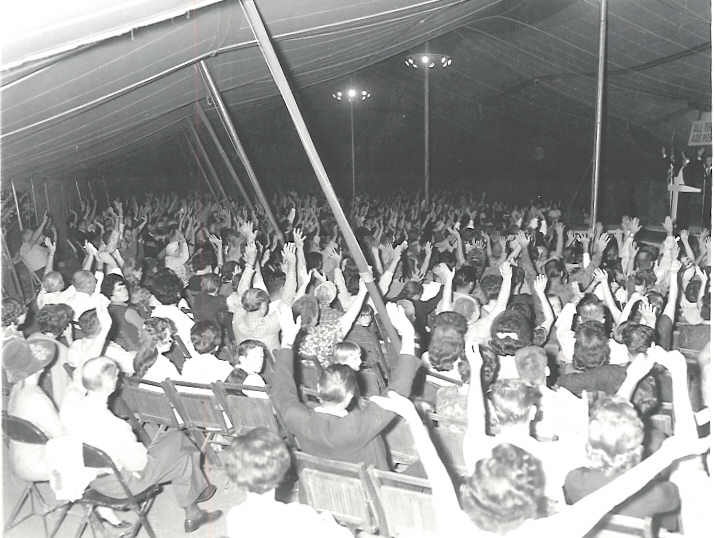
A week-long church fest featuring an overly eager guest speaker? Popping the tent and slapping the tambourine? Maybe even smacking someone upside the head to heal them?

Most of us have come to associate the word revival with an intense, focused (and staged) event intended to jar life back into the church congregation and create a “great awakening”. It’s supposed to replenish us, like we are a bunch of spiritual squirrels filling our cheeks and running back to our trees to store up for the winter.

In my personal experience, I’ve not seen many genuine situations where a church body enjoyed true revival. I’ve seen a temporary frenzy that fostered fleeting episodes of group think and follow the crowd mentality akin to the popularity explosion of the Snuggie or Justin Bieber. Those “revivals” are often short-lived and then it is back to business as usual until next year. I’m not suggesting a church body can’t experience true revival. I just think that when it does happen, it is more organic and inspired than the revivals I’ve been a part of in the past.

For me, revival is about a renewal of your fervor and desire to pursue God. Or it can be a restoration and healing related to a dark tragedy or deep wound. It occurs on a personal, not just a population, level. 

My revival happened two years ago and has been rekindled probably about every two weeks since then. I was in a slumber, and then I received a spark. And quickly, I’ve seen the spark fade and then brighten again, over and over.  If I’m being honest, it’s all I can do to keep it alive and “stay awake”. So far, it’s been worth the effort.

I guess my point with all this is that 1. you don’t need to wait for “potluck week” to have a personal revival, or your own great awakening and 2. while revival is a sudden combustion of flames, it can burn out just as fast if you don’t nurture it. In the end, I encourage you to displace your initial reaction to the word revival (at least if you carry the same baggage as me) and consider how you can achieve something much more powerful underneath a tent made for one.

Areas of Interest

Past Stops on the Journey

Enter your email address to subscribe to this blog and receive notifications of new posts by email.

Join 21 other subscribers

Top Posts