
You are currently browsing the category archive for the ‘Relationship’ category.
There we were, hemmed in the corner of a music joint downtown, which at capacity probably holds 75 people. Appropriately called The Basement, it was darkly lit and homey, a small stage front and center. Posters of shows gone by stapled to the ceiling amidst the ducts and piping. An eclectic mix of Nashville natives hungry perched and waiting for original tunes.
I was there to see an old friend perform, and I dragged a couple of guys with me, promising them the band was “folksy” and sounded “a lot like Johnny Cash.” Somewhere along the way, my friend had taken a left turn musically and gone hard rock on me. Needless to say, he and the band did NOT sound like Johnny Cash. Apologies again to my friends for false advertising. But that’s not the reason for the post.
Before the second coming of Johnny Cash took the stage, we had the pleasure of hearing a trio of brazen youngsters who were playing their very first set ever. They cranked up their introductory song, which posed the question, “Is my Jesus gonna come back?”
I laughed inside. Surprised to hear from God in a place like that. Late on a Saturday night, jamming to local talent in a basement. And there He was. As the band played, reciting the question time and again, it got me thinking. There is so much focus on the second coming, the return of Christ. Experts try to predict it. We debate whether signs of the end times are upon us. We talk about it in church.
It makes it easy to forget that the Jesus we worship isn’t just up and out there somewhere. He’s right here with us. For me, I too frequently scan the skies for a glimpse of Him, pray upward to Heaven like it will take the world’s tallest elevator to deliver the message. I create the fallacy in my mind that this is only a long-distance relationship.
We serve a living God. And yes, there will be a second coming.
In the meantime, we shouldn’t lose sight of the fact that just because He is coming back doesn’t mean He ever left.
It’s a paradox that gets misconstrued far too often.
We can look fondly to a day when we are reunited with our savior. But we shouldn’t overlook the fact that He is walking beside us in the meantime and that we don’t have to wait for “the return” to have “the relationship.” We serve a living God. We serve a relevant God. We serve a present God. And evidently, we serve a God who will even hang with us on a Saturday night to catch some live rock music.
Right here. Right now. Ironically Jesus Jones sings that song. It’s true of that other Jesus as well. He’s right here. Right now.
I’ve been working on this post for a few weeks now. It’s been exceptionally hard to successfully fight for 15 minutes of uninterrupted writing time. Finally, I’m here. The good news is that God has continued to reinforce this content with me several times. It seems I’m exposed almost daily to a quote or situation or song where this is the featured subject matter. It’s like He doesn’t want me to forget the topic at hand before I sit down to capture it in written word. He knows me all too well.
We all have wounds. Delivered to us at an early age. Dug deeper over time and with experience. They run to the bone. They bleed. The real problem is we are experts at self medication. We cover these wounds. We numb the pain. We distract ourselves from them until we no longer can feel the gaping, gushing hole. Until we no longer even acknowledge they are part of who we are.
I’m learning that it is much better to expose wounds. It’s not always the best practice for physical ailments, but when it comes to spiritual aches, band aids and wraps and medicines only infect and disease. They cause wounds to fester. If we fail to expose our wounds to our consciousness and air them out, they will produce emotions that take over. Emotions require energy to sustain themselves. They feed off actions and reactions. This generates sin. It’s really a vicious cycle.
I unintentionally put my family in danger recently because of this very thing. I have a wound. I’ve discussed it before. It has everything to do with not measuring up. Needing validation. When I allow myself to suppress that wound, bury it, temporarily put it out of my consciousness, I breed emotions that demand actions to thrive. Those actions can range from shouting to outbursts to tears to self deprecating humor. I magnify obstacles and build mountains out of mole hills.
On the day in question, I freaked out just a bit about being late (mostly because of a string of dumb mistakes on my part) and made a few ill-advised maneuvers on the road in our swagger wagon (which is code for mini van. you must watch this video: http://tiny.cc/6b70p). In the process I found myself in a situation where a very scary guy was attempting to follow us home to enact revenge for my temporary NASCARlepsy. For just a moment, I let rage consume me. And I put myself and my family in potential danger. If you suppress your wounds, you make them impact you more deeply. And they can set snowballs into motion that have the potential to generate avalanches.
If we maintain our awareness of the wounds we have, and the likely emotions that result, we can prevent some of the negative scenarios from playing out, or at least react and respond better amidst an emotional flare up. We’ll understand the cause of what we’re feeling and see more clearly how to positively impact the effect.
James 1:23-24 – Anyone who listens to the word but does not do what it says is like a man who looks at his face in a mirror. And, after looking at himself, goes away and immediately forgets what he looks like.
We have to be self-aware. We have to expose and embrace our wounds. Keep them top of mind so that we can readily understand the emotions when they present themselves. If you name your wound and keep it present in your mind, you limit the power it can hold over you.
Conversely, I’ve also been told by God in COUNTLESS ways as of late, that my wound can actually be my weapon.
I was recently in church for the first time in six weeks. Immediately, the worship leader shouted from the stage, “Our ministry can come from our misery.”
Shortly afterward, we sang a song called Beautiful Things (http://tiny.cc/t7se7). Talk about powerful. There is a line in the song that asks, “Could a garden come up from this ground?” Of course the answer is yes. As the chorus goes…”You make beautiful things out of the dust. Beautiful things out of us.” This preceded a sermon on using spiritual gifts.
About the same time, a new friend shared a quote from Robert Bly on my blog in response to an earlier post I had written: “Where a man’s wound is, there he will find his genius.”
And finally, just last night, I was reminded that my deepest wound can and will be my gold, my gift, my genius. Basically, God has stopped just short of renting out one of those billboards where He writes in white against a black background and offers a pithy quote. I thought I should go ahead and get this post up before He blew any of His advertising budget on me.
So I leave you with a few questions that I’ve begun asking myself. What sins are you feeding your emotions? What wounds are causing those emotions? What would it take for you to starve the emotions and remove the sin? How can you make this very thing in your life that breeds negativity and transform it into a positive and powerful force?
It’s a simple, three-step process. First, expose your wounds. Then, embrace your wounds. And finally, exploit your wounds for the genius they hold inside. Let your misery become your ministry.
A few days after the Nashville flood, my five-year old approached me and said, “Daddy, can we give toys to the other little boys who got all the water?”
“How cool is that?” I thought to myself. My kid is volunteering to give away some of his toys to flood victims. So, we rounded up a small box of toys and set it on the counter to take to the church.
Later that afternoon, we were in Target, and my son took my hand and led me toward the toy aisles. He told me we needed to get more toys because he gave his away. A ha! Ulterior motive. At five! New toys for old toys. That is a smooth move.
His heart was actually in the right place. And although he missed the point in the end, he was on to something. He was making room for better things. Old toys for new ones. Giving something that might be perceived as good to create space for something great. Okay, it’s not the best approach for charitable actions, but it is how I need to approach my walk.
God has asked me countless times to let go of certain things in my life. To make space. To make some sacrifices. And in return, he promises something so much better. Something great for something “good” that might not even be all that good anyway. And yet, like most, I grip tightly to my old toys, I pull them in close, I hover over them and slap away anyone who would encroach. Meanwhile, the one who approaches is simply trying to trade out the old ones for shiny new ones. Something of greater value. Much greater value.
Do you have any old toys lying around? If so, pack them up, move them out and make some space. See what God puts in their place. I bet it is much better. As for my toddler, he didn’t get any new toys at Target. And we never got around to dropping off the old toys for donation. That feels really familiar to me. Getting as close as boxing up the old stuff, but not quite getting it out the door. Being so close to the new toys, yet so far away from bringing them home. Tomorrow is another day, another opportunity to create some space for God to work, to clear out the old and make room for the new. To receive so much more than I give. All I have to do is let go, and let God.
“A man’s gift makes room for him, and brings him before great men.” – Proverbs 17:14
Hello again. Miss me? I’m supposed to be feeding the lake every day this year, remember? Well, I hit quite a dry spell and allowed myself to collect dust. Luckily a flood, literally a flood, helped me get back in the flow.
I just returned from an “all in” kind of weekend. I was terribly afraid of it, feared it, dreaded it. And that was before multiple feet of rain washed our campground away. But I committed to it and put it in God’s hands. In the process, I learned that my greatest wound is possibly my greatest weapon in the fight for God’s kingdom.
I have a need for validation, affirmation, approval. I’ve been screaming for it. I’ve struggled mightily with it. And I have let it consume me. What I learned on this weekend, as a torrential downpour pushed our group all over the Franklin area, is that this gaping hole in me has given me great compassion and insight for others. I also learned that I’m not alone.
All this time, there have been many others dealing with exactly the same kind of thing. And I was doing nothing for them. While I wallowed in self-pity about validation and affirmation, I was sharing none of it with others. I was oblivious to similar needs of people very close to me. I was boxed in, staring at my navel, contemplating why things are the way they are. Woe is me.
It’s amazing how we’re led to believe we are all alone in our struggles, like no one else is feeling the same way or wrestling with the same issues. When the truth is, no matter what you are combatting, countless other people out there share your pain. The world tries to isolate us. Just like any predator and prey situation. Think of a sheep being attacked by wolves. Think tipsy girl at a bar. The predator tries to separate us from the pack and isolate us. Prevent us from feeding on the strength and support of others. Limit our ability to empathize and share common trials.
We’re made to believe we are the only one dealing with our situation. There we are alone, left to battle the predator single-handed. All along truly believing that no one can relate to what we’re going through.
I started my journey alone. It was me and God. And that’s okay. But on this rain-soaked weekend, I learned that I can only go so far in isolation and that walking this path with others will significantly increase my chances of getting where I want to go in my trek toward a closer relationship with God. There are people who understand my struggles. People I can help, and people who can help me. Again, my wound can indeed be my weapon.
There is great power in numbers. I am not alone. And neither are you.
One of the most helpful strategies for me in my journey has been to take a closer look at myself. In continuously diagnosing where I am, I increase the likelihood of reaching where I want to go. After all, the most important key to solving a problem is accurately defining it. Most of us are not naturally self-aware. Myself included.
I recently found a passage and a parable that has not only helped me as a diagnostic tool but also provided me with a model for more effectively approaching my faith walk. Luke 8: 11-15 talks about seeds scattered, some falling by the wayside, others on the rock, others among thorns and finally those landing on good ground. The parable goes on to describe what happens to each group of seeds. I’ve adapted it below to put it in categories that work better for me, using descriptors that are emblematic of our most common challenges as Christians. It’s important to note that three of the four categories are negative. It’s also important to note that you can find yourself in more than one at a time, although I’d bet that you can always identify more strongly with a single category.
Walls – Like the wayward seeds, you have heard the word but it has been quickly taken from you, and you don’t believe. You’ve built walls of doubt. You are cynical about God and skeptical about what He can do for you. Maybe you even question the very existence of God. Either way, you lack the belief necessary to progress in a relationship with God.
Chains – Like the seeds that fell on the rock, you have no roots and temptation quickly causes you to fall away. You are owned by sin, consumed, trapped, unable to exert self-control. You fall into the same snares over and again. You feel like you can’t overcome human nature.
Idols – Like the seeds that fell among the thorns, you are choked with cares, riches and pleasures of life. You likely have your priorities out of whack. You consistently experience fear, worry, stress. You are trusting in yourself instead of God. Focusing on things that expire instead of things that are eternal.
Fruits – Like the seeds that fell on good ground, you are producing. You are patiently progressing toward a deeper relationship with God. You have momentum. You are on a journey.
So where do you fit?
If you find yourself stuck behind walls, your main struggle is with your ability to believe. In your mind and your heart, you have to buy in to the salvation story, to the promises God has made. You might have to find ways to come to grips with doubts you have or internal struggles which prevent you from believing. If you are bound by chains, your fight involves obedience. You are failing to follow God’s instructions for your life. You have to gain small victories in resisting sin and build from there. Those in the idol category are misplacing their faith and trust, finding purpose in worldly things, relying on things other than God to sustain them. And finally, those of you fortunate enough to find yourself in the fruits category are experiencing growth, making progress in your pursuit of God.
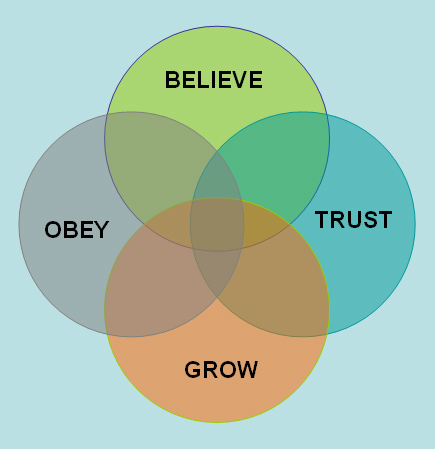
This model, or framework, helps me organize my approach to growing with God. It also ties directly to my earlier post (You Are Not Alone), where I discussed 2 Peter 1:5. I believe as you progress in this model, you begin to outwardly display the attributes from that passage. Faith. Virtue. Knowledge. Self-Control. Perseverance. Godliness. Brotherly Kindness. And finally, Love. If you are able to more completely believe in the promises of God, trust Him and pursue him above all else, resist temptation and be obedient, then you will grow, your roots will deepen, and you will produce much fruit.
Give privately. Receive publicly. I don’t know about you, but I could not be more backwards about this if I tried.
We do our real business with God in the backroom. We unpack our bags and get real. With no witnesses. No one to see the grace and the mercy and the impact. In public, we suit up and serve. We make grand gestures. We make sure to be seen sowing. Actually, I should use the pronoun “I” and let others decide whether this fits them as well. Sorry to project.
A while back I heard a sermon on giving in which the presenter emphasized that we are called to give anonymously. That we should not draw attention to ourselves in service. (Give privately)
Meanwhile, I’ve seen people with very public struggles who have not only turned their lives around but also positively influenced others in the process and served as glowing endorsements of what our God is all about. (Receive publicly)
There is a parable in Luke 8:26-39 about a man possessed by demons. He approaches Jesus in a crowd, desperate to be healed. Jesus obliges, driving the demons out of him and into a herd of swine who run downhill into a pond and drown.
A few interesting things about this story (other than pigs running downhill into a pond to drown). 1. His plea for help was a public one. (As is the case in many parables like this one). 2. The people who witnessed the feat were also greatly impacted. They immediately ran to tell others what they had seen. 3. The people they told came to see for themselves, but they reacted with fear, and that fear was contagious. The entire region asked Jesus to leave because of this fear. 4. Jesus responded by instructing the man to go back to his home and tell of the miracle. He did so, proclaiming to the whole city what Jesus had done.
Quick question. What if he had approached Jesus in private, one on one with no witnesses? And what if he then kept the miracle of his healing to himself and didn’t share it with the world?
I believe there are two basic challenges that heavily contribute to the flip-flop that I’ve been experiencing.
The first challenge I see is that most churches emphasize service at the expense of personal growth. When the main statistic to judge success is the number of “professions of faith” then I think we miss a big, big part of it. Is it important to reach more people with the Gospel and to lead more people to Christ? Is it important to serve and to give and to do good? I’d have a hard time saying no, obviously. But what I’ve come to realize more deeply is that our primary purpose on this earth is to be in relationship with God, to honor and worship Him, to simply be with Him. The rest of His plan will unfold from there. But it is easy for us to experience guilt when we feel compelled to spend time working on ourselves. Sorry, I’m doing it again. It’s easy for “me” to experience guilt.
The second challenge I see is that most Christians are like me. They are driving in reverse. Receiving privately. Giving publicly. They get overly concerned about damaging their witness, and forsake opportunities to be real, open, transparent and yes, flawed, when interacting with others. They seek redemption in the privacy of their own homes, but stand tall in public, demonstrating the good they are contributing. The best role models are not beautiful. They are broken. Just like the man with the demons inside, the power lies in witnessing the grace and goodness of God.
No wonder fear is such a common emotion for us, just like the people in the parable. When we see this in action, or think about doing it ourselves, we freak out. We are afraid. We don’t know how to respond. It’s just too weird and uncomfortable. This man, and his approach, should be the rule, not the exception.
I will be honest. This is one of the biggest struggles I have. It scares me to death to put my flaws out on display, to truly open up and be me (good, bad, ugly). So, I’ll be up front and say that I am definitely not practicing what I’m preaching. Yet. But that doesn’t mean I don’t get it. I do. So now all I need is a herd of pigs, a pond and a little bravery.
Last night, I had the pleasure of doing one of my least three favorite things: attending a wedding. It’s not that I have anything against the institution or anything. It’s just that suit + strangers = a very uncomfortable situation for me. And that’s before you get to the reception where you mix in dancing with strangers (sounds like a great new reality show).
This wedding was rather painless as weddings go. Nice, short ceremony. Good food. Interesting people. And I even let my wife drag me to the dance floor for a few songs. Back to the interesting people. At our table, we had a young couple from San Francisco, a couple who recently moved back to Nashville and were expecting their first child in a few months, and a martial arts expert who spent the last 15 years training young men for special forces assignments. He formerly was the one accepting special forces assignments, going on covert, top-secret, high-danger missions across the globe. I sized him up, fascinated that I had the exact same size and build as this Chuck Norris character. As he talked about some recent cage matches he had attended (seriously, cage matches), I joked that I would last about 20 seconds in a cage (depending on how long it took the other guy to catch me). He responded very matter of factly by telling me it’s just all about training, like everything else.
Later, as the conversation continued, he posed a question. “Why do you think that elephants at the circus can be restrained with just a small chain on their leg? Don’t you think they could break that very easily?” He went on to explain what he called “the elephant theory.” I feel like I’ve heard this before, and assume that anyone reading this likely has as well. But combining his brief explanation with a quick and dirty Google search, here it is.
Supposedly, when an elephant is young, a chain is placed around its leg, the other end fastened to the trunk of a tree. After several attempts to wander past the boundary imposed by the chain, the elephant realizes it can’t break free and so it adjusts accordingly. When fully grown, the same elephant can be restrained by the same chain, despite the fact that it could easily rip it apart, because it has been programmed to believe the chain is too strong. Resistance is futile. The chain wins.
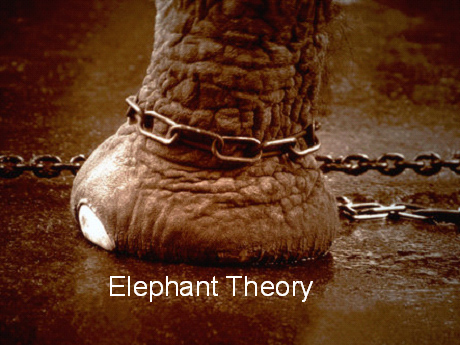
As I was sitting down to write my blog post for today, the following analogy came flying right at me, so thank you Chuck Norris. I have no doubt it has been used in countless sermons. I am under no delusion that I am the first to successfully map “elephant theory” back to a spiritual truth. But God did share it with me, so I’m paying it forward.
A struggle I have is that I feel like I’ve been programmed, unintentionally, to be chained by sin. At an early, impressionable age, we all learn that we are not worthy of salvation, that it is by grace we are saved, not through works. Please understand, I believe that to be true, 100 percent true, but I also believe that many of us are set up for failure in our walk because we hear “you can’t overcome sin on your own” but internalize “you can’t overcome sin.” Uh oh, just missed a few important words on the end of the transmission. Two big words.
Even if we get it right in translation, this truth is what chains us when we drift from God. I wrote earlier about idols, meaning things we rank in front of God, and how they impose an utter lack of prioritization. Here we are talking about chains, the self-imposed challenges we place, building on the idols in our lives with a complete lack of trust in God. We’ve been trained that we can’t overcome the tiny chains of sin. And we don’t trust that God will provide. So we are leaving it up to ourselves, and we know we can’t win.
What is the outcome of this madness going to be? A powerful elephant that could be demonstrating its strength is instead led around by a small chain for the world to witness its weakness.
It’s not just that we do a bad job of internalizing the teachings and trusting in God. We also are all human, and have all made mistakes. And just like elephants, we have long memories. It’s funny, I sometimes leave the living room and forget what I needed before I get to the kitchen, but I never forget for one second any significant transgression or failure that I’ve had in my time on this planet. Whether they be spiritual struggles or otherwise. By holding on to these past transgressions, even the ones we’ve served up to God, we create chains. We tie ourselves down. We place ourselves in bondage. We accept future limitations based on past truths. We don’t for a second stop to think that we might be stronger now, or that we could grow stronger. We are defined by a past we can’t forget. We can’t run because of chains, despite the fact that we could shed them fairly easily.
It is a very effective tactic for Satan to use against us. He takes a truth about us not being worthy, and then uses that deeply seeded belief in unnatural ways to construct a chain that says because of this, we can’t successfully overcome sin. Because of this, we have failed and will fail again. Because of this, we also aren’t worthy to pursue God, to be in community with God, to have a deep relationship with Him, to contribute to His Kingdom. I don’t think many of us consciously think like this, but it’s the internal hopeless feeling that many of us have about our current situation where this comes into play. We haven’t fully trusted God, and we’ve failed on our own, so we just pace in circles around a tree, accepting the limitations imposed on us by our selves and our surroundings. You’ve heard it. You’ve said it. “I can’t change this. I can’t do anything about this.”
Oh yes you can. And you can start by forgetting what isn’t possible in the first place.
Philippians 3:13-14 No, dear brothers and sisters, I am still not all I should be, but I am focusing all my energies on this one thing: Forgetting the past and looking forward to what lies ahead, I strain to reach the end of the race and receive the prize for which God, through Christ Jesus, is calling us up to heaven.
Once again, thank you Chuck Norris. I am in training, and have been in training for a while now, preparing for my own cage match. This training will equip me to overcome any physical, mental or spiritual limitations of mine that would give an advantage to my enemy. I can’t wait until I get my mind right, forget the preconceived notions built by the past, rip this chain off my leg and start running to freedom. Care to join me?
I was saved at the age of 11, during Vacation Bible School. The pastor finally spoke in words I could understand, using the game of baseball as an analogy for salvation. It still took my cousin wandering down the aisle before I was brave enough to do so myself, but on that day, I became a Christ follower. Finally, my grandmother could put her hand down. You see, every Sunday, the pastor would ask for unspoken prayer requests, and she would raise her hand. Later on, I realized, I was the unspoken request that was burdening her. But I digress.
And with that public profession of faith, I fell into a lifelong trap that sidetracks many Christians. I thought I should immediately be transformed, with a new heart and a new mind, membership in the club being all I needed to be whole. Born again after all.
Some quarter of a century later, this is still one of the main reasons why I find it so hard to deepen my relationship with God. Why many of us, I will assume, still struggle with that. We have the equation all wrong. Salvation = Faith = Mission Completed. The church actually does talk about deepening your relationship with God, but for some reason it has always felt to me like it overly emphasized the transformation that occurs when you accept Christ, making it a divine transaction instead of the beginning of a deeper journey.
2 Peter 1:5 – For this very reason, make every effort to add to your faith goodness; and to goodness, knowledge; and to knowledge, self-control; and to self-control, perseverance; and to perseverance, godliness; and to godliness, brotherly kindness; and to brotherly kindness, love.
Wow, that passage displays a process with many steps that we tend to either skip over or take on all at once. It is no wonder we burn out before we catch fire for God. We try to bite off a big chunk of godliness, for instance, before we spend time gathering knowledge and learning self-control. I’m not suggesting this is a process that must absolutely require a set amount of time. In fact, I’m sure that some people move through the steps more quickly than others. I am saying that the order is important. How can you consistently dismiss sin and persevere if you haven’t gained an understanding of what it takes for you to build self-control? From faith, it all builds. Faith grows stronger along the way. But from faith, you must build.
I must say that again in my 25 years of Christianity, it wasn’t until this week that I had this level of clarity about where I’d been going wrong in earlier attempts to walk with God. Partly because I was just not being aware or open to hearing from God. Partly because when we gather together corporately as Christians, we don’t always create an environment conducive for growth.
Everyone shows up with their Sunday best on, and by appearance and attitude we create an illusion that all is well on our peaceful walk with God. We’ve been transformed, and we are whole. Mission completed. In the meantime, we create the belief that if you are struggling with faith or dealing with sin or drifting from God that you are all alone. A misfit in some way. You just don’t get it.
Occasionally, we see the courageous comeback story of someone who has rebounded from drugs or alcohol or overcome abuse or tragedy. Call me a pessimist but these stories, while inspiring, usually leave me feeling more alone in my struggle because in addition to these stories being positioned as exceptions to the rule, they also are usually examples of people who are actually back on track. So for those still in the midst of a relationship crisis, the message can be that indeed we are alone. There were a few people out there like us. But now they are back in the game as well. It might just be me, but after several recent conversations, I don’t believe that to be true. And while deep down we know that “all have sinned and fall short of the glory of God,” it doesn’t stop our imagination from placing us on a deserted island.
It’s a viscous cycle. The reason for creating the illusion is because most of us are afraid to be real and open up. And because of this fear, we perpetuate the fear in others that they are alone in their struggles, making their problems seem bigger and badder and that they have failed because everyone else seems to be doing just fine. It also creates the belief that those of us who aren’t where we want to be can’t offer any value because of our flaws. How quickly we forget the achievements of men like the disciples, who were riddled with shortcomings and weakness but did great things despite them.
If we would all pause and remember that it is the pursuit of being Christ-like, not actually achieving it in full, we would be in a better place. We might not be so afraid to let the world in and see that we don’t have it figured out. We wouldn’t unintentionally alienate others who really need support but aren’t comfortable being “the only broken ones.” In protecting and guarding ourselves, or putting on a mask because of pride, we perpetuate a collective aloneness.
I’ve also struggled with a seemingly widespread tendency of Christians to mistake holding people accountable with judging them. We’ve all done it, and we’ve all had it done to us. I see it all the time. People who are strong in their faith and well-intentioned but then write someone off or place a black mark next to their name in the spirit of “holding them accountable” when really, they are judging them for not being transformed and whole. It is not our place to forgive when there isn’t an act that directly impacts us. People don’t need to be judged. They don’t need to come to a place of worship or a community of believers and have to consciously monitor and censor themselves out of fear that someone will render a verdict and condemn them as spiritual criminals or deviants. Usually if I am tempted to judge someone, it is because I need to feel better about where I am and what I’m dealing with. It’s the only way I have of telling myself that I’m not so far off the mark after all, that I’m not alone.
Considering all this, I’m going to take the same stand as one of my very good friends, who just the other day told me that he refused to live in fear any longer. Amen! This can be done by me being fully aware of where I stand in the process. For me, that means the knowledge phase. Next up, self-control. It also means that I have to continually remind myself that just like public speaking, most everyone is uncomfortable with where they are in their walk with God. I am not alone. And neither are you.
There is a pile of mail on my counter. There are 655 emails in my spam folder (since this time yesterday). There are 5 voicemails waiting on my office phone. There are 27 unanswered emails in my work inbox. I missed two meetings today. I attended 8 others.
Depending on which research report you reference, the average consumer will see or hear 800 to 3,000, maybe even up to 5,000 marketing messages per day.
I don’t know anyone who can process that much information. And since we are physically and mentally unable to take in and evaluate that volume of data, we develop the ability to tune out, to automatically filter the noise. At some point, we stop seeing the billboards on our daily commute, we fast forward broadcast commercials (thank you DVR!), we channel hop on radio breaks, we can even make newspaper ads disappear through tunnel vision while we read a breaking story. Our brain develops the ability to only focus on things that might be of interest. It’s a survival tactic. It keeps us from a hard drive failure.
We do the same thing with non-marketing situations as well. Think about the chaos of a regular day. For those of you without small children in the house, take whatever chaos you have in your life and use somewhere between 800 and 5,000 as a multiplier.
Where are my keys? Where is my wallet? What time is my first meeting? Who was I supposed to meet for lunch? Don’t forget to send that email, or to pick up the dry cleaning, or to call about getting that home repair scheduled. This doesn’t even factor in all the crisis situations we might be dealing with, such as stress at work, stress about losing work, health problems, deaths in the family, etc., etc., and so on.
The point is that we live filtered lives. Twice last week during a two-day team building this truth was revealed to me. One of our speakers was talking about our ability to filter marketing messages. The second was talking about how quickly we get lost in the day at hand and lose the ability to “just be” because of multitasking on overdrive. We can’t gain perspective, because we are just trying to make our way down a mental checklist.
This is exactly why we find it so hard to hear from God. We have lost the ability to listen. We are too busy filtering out potential opportunities to walk more closely with Him because they just don’t fit into what we’ve programmed ourselves to accomplish day in and day out. We can’t listen because we are multitasking like crazy, and crashing as many things into our schedule as we can possibly fit. We get so consumed in our daily lives that our daily walks just don’t happen. They get screened right out.
The upstairs air filter in my house is hopelessly overdue for a change. I honestly don’t know how any air is even getting through at this point. I will get to it tonight, so no worries. But that is exactly what my mental filter looks like. It’s crammed with fuzz and static. Until I change it out, I won’t have the space I need to truly listen. My filter also unintentionally tags a lot of things as noise that might actually be something I need to hear or see. So, when I put in a clean one, I also need to put in a different kind, one that frees up space for unexpected messages and insights.
Finally, I need to take it off autopilot. Leaning on the filter to do all the work for me is what gets me in trouble in the first place. I need to slow down, stop even if that is what it takes. And listen. And look. And just be. Maybe even catch a billboard or two.
Why do Christians love to debate theology? Whey do we get so hung up on differences in philosophy, belief and approach? I feel safe saying that most Christians, and Christian institutions, have pretty much the same core set of beliefs and values. Instead of focusing on those core beliefs, we spend way too much time fighting battles on the fringes, debating in the gray areas, getting hung up on differences in opinion and interpretation.
I had the opportunity recently to spend some extended time with a group of highly passionate Christians. Over the course of two days, I witnessed debates on whether a poster was art or pornography and whether meditation was good or evil, among other things. It seemed that everyone had formed a deeply rooted system of beliefs and perspectives, and as a result, they had trouble keeping their minds open to other points of view. Unfortunately, I think we do that a lot as Christians. The challenge is that we can quickly slide into legalism and judgement and alienate people who aren’t ready or able to adhere to the same set of values that we have. The real problem is that in most cases, it’s not central theology at the heart of the debate. It’s on the fringes. I believe God provided us with a multitude of options in this world to do life and to be in relationship with Him. I also believe that while the Bible is very clear on the core beliefs we are to have as Christians, it holds quite a bit of gray on a host of other topics. Just because we have settled on one of the translations for some of these gray matters doesn’t mean we are right and all others are wrong.
 I recently stumbled upon an interesting book in the bargain bin at the bookstore. Self-proclaimed agnostic author AJ Jacobs wrote The Year of Living Biblically: One Man’s Humble Quest to Follow the Bible as Literally as Possible a few years ago. In it, he journaled about his quest to follow each and every instruction in the Bible for a full year. I haven’t read the book, only the jacket. I’m sure parts are funny and parts are offensive. I didn’t buy it to find out.
But it did get me thinking. Is that what most people view it to be like? You receive a Bible, and then you have to try to literally abide by all the rules within it? That isn’t very inviting, and it’s not very realistic either. It’s not attractive or attainable. Or appropriate if you ask me. I would encourage us all to open our minds a bit and to be more accepting of differing opinions and approaches to issues that are outside the core. Baskin Robins serves 31 flavors of ice cream. But it’s all ice cream, with a consistent core. Most of them are deliciously different from one another. That’s how we should look at living a holy life. There is a base, a common set of elements that make you a Christian. And then there’s the rest of it. I’m just not so sure it’s smart for us to deeply form opinions on the fringes and allow that to dictate both the way we live as well as the way we view other people.
 the way to (t)here

What You Said