
You are currently browsing the category archive for the ‘Purpose’ category.
Today’s post will be a little shorter than usual. Just getting right to the point with this one.
Over the last year, I’ve learned a lot about myself. My past. My future. My present. How to live life. How to trust God. How to make sense of things that don’t make sense. How to be present. Along the way, I’ve picked up some effective ways to help me zero in on what I’m feeling and more importantly, help me say or do the next right thing. This doesn’t mean I always say or do the next right thing. But with every passing day, I get better at that.
Here are the three small phrases that are currently making a big difference in my life, and I think if you try them out, you’ll see they will make a big difference in yours as well.
- But Why… Whatever you are thinking or feeling, whatever emotion is rising up within you, it is the product of an unmet need and/or an unhealed wound. Usually, there are layers upon layers that we have to peel back before we get to the bottom of it. When you catch yourself overreacting to a situation or feeling something that is unsettling, or being tempted to do something that isn’t good for you, pause for a second and ask, But why?” Try to uncover what’s driving your bad mood, your craving, your unhealthy response or your negative thoughts.
- So That… This is a powerful one. Everything happening in your life right now is under the specific instruction of a power higher than yourself. Ask what God has for you in this current situation. Whatever the trial, obstacle, adversity or suffering you find yourself in, there is a “so that” to it. I heard this phrase for the first time while attending my local church several months ago. Liked it so much, I stole it and have been using it ever since to remind me that even when I don’t understand what God is doing, there is a point to it. A bigger picture. I just have to be patient enough to let Him work.
- And Then… I use this when faced with choices and decisions. What is the likely outcome, consequences, etc. to choosing path a over path b. If you are in pain and wanting to medicate in any way to avoid it, you must know that the pain will still be there waiting on you when you’re done, and you’ll also have the consequence of your medicine of choice (which depending on the individual ranges from alcohol to drugs to pornography to binge eating to shopping to gambling to burning hours on social media). If you respond to your current situation out of an unstable emotional state, you will damage the relationship or the scenario even further. Sometimes just being able to see the potential fallout from an unhealthy decision is enough to help you make a healthy one instead.
All three of these phrases are a part of my daily vocabulary now. I’m doing my best to be present in my decision making, in my daily actions, in my relationships, in each and every hour I’ve been blessed with from above. Too often, we go through live in reaction mode, with no real perspective on what is happening to us, why it’s happening and what will happen next. Practice these three phrases for a week, each and every time you get the opportunity, and I bet you feel better equipped to deal with your life in a positive way.

I recently watched a television special on ESPN featuring the story of Southern Methodist University and its football team’s infamous journey from rising national powerhouse to being wiped off the map by the NCAA’s death penalty in 1985. For all the non-sports fans out there, SMU cheated in 100 different ways to build a winning football team, and after several rebukes by the NCAA, its program was effectively destroyed by the harshest punishment in NCAA history. The program is only now showing signs of life, more than 30 years later.
Many of the people who created the cheating culture and conducted the majority of illegal and unethical behavior were long gone by the time the NCAA brought down the hammer. The head coach who was there when the ship finally sank wasn’t the one who set course for the iceberg. He just couldn’t steer the ship clear in time. That fate had been set in motion and could not be avoided.
This is a great example of the long tail of sin. The echoes that mistakes can make in times to come. The consequence, sometimes delayed, of regrets, wounds and weakness.
It can seem unfair, when the echoes come. When you think you’ve seen the worst of it. So relieved to have it behind you, whatever “it” is, and to be starting over. But the consequences aren’t always immediate. Sometimes, your mistakes set into motion a series of other painful events that are yet to unfold in your life. The tendency, at least for me, is to then ask God what in the world He thinks He’s doing. Why is He continuing to punish you for the mistakes you made? Why is some of that punishment delayed? Why now? Why isn’t He restoring instead of destroying? Why is He hurting (you and others) instead of healing? Why is He not choosing to create a happy ending here? We expect that once we’ve repented, once we’ve made amends, once we’ve given it all up to God, it’s time for the miracle, the redemption. That is all true. But if the ship has been directed at an iceberg, God makes no promises that you won’t still hit it.
“Your affliction is incurable. Your wound is severe.”
That’s a quote from Jeremiah 30:12-18. This passage says that you’ll be bound up, have nothing to heal you, be forgotten by your lover, all because of the multitude of your iniquities and the increase of your sin. And then, it asks a hurtful question.
“Why do you cry about your affliction?” As if it should be assumed that this is happening.
At the end of the passage, after explaining that you are receiving grave consequences because of your sin, it says God will “restore health to you and heal you of your wounds.” Those incurable, self-inflicted, devastating wounds. God’s plan is perfect, even though it can be painful.
Another passage, Malachi 2:13-15, says, “You cover the alter of the Lord with tears, with weeping and crying; so He does not regard the offering anymore, nor receive it with goodwill from your hands.” As you read along, it continues, “Yet you say ‘For what reason?'” The passage answers the question, stating that the Lord has been witness to your transgression.
Alexander MacLaren is one of my favorite commentators on scripture. In his examination of these verses, he says:
“Every sin draws after it evil consequences which work themselves out” in your life. “The miseries which follow our sins are self-inflicted, and for the most part automatic.”
In other words, you will reap what you sow. I guess that cliché is true after all. He continues, “If we understand the connection between sin and suffering, and the fact that the sorrows which are but the echoes of preceding sins have all a distinctively moral and restorative purpose, we are prepared rightly to estimate how tenderly the God who warns us against our sins by what men call threatenings, loves us while He speaks.”
And just like the previous scripture in Jeremiah, there remains a promise for redemption.
“No sin can stay our reception of a multitude of good gifts,” said MacLaren.
Sorrows as echoes of preceding sins. That’s really hard to accept. Especially when you feel like you are no longer the person who set the ship on a collision course with the iceberg in the first place. When a changed heart, and a revived spirit is within you. When you’ve begun to transform your life. When you do the work. You likely expect it’s now time for restoration, hope, reward, joy. Not the beginning of an even more difficult journey.
Sometimes, that is true. And sometimes, the long tail of sin still has to work its way out of the picture. And the tip of that tail is most likely the most painful part of it.
I encourage anyone out there who is trying to change, to rebuild, to make things better, to understand that the echoes won’t last forever. At some point, you’ve hit the iceberg, put the pieces back together, and you start winning again. It may feel like forever. But the consequences will work themselves out in your life. In the midst of the echoes is not the time to give up on your God. Even if you are losing what you dearly love. It’s exactly the time when He’s getting ready to do His most miraculous work. It’s not a convenient process. But you can’t argue with the conclusion. It’s hard. It hurts. I don’t know why things are unfolding as they are for you. I can’t even begin to answer that question for myself at the moment. But I want to see how the story ends. God tells great stories.
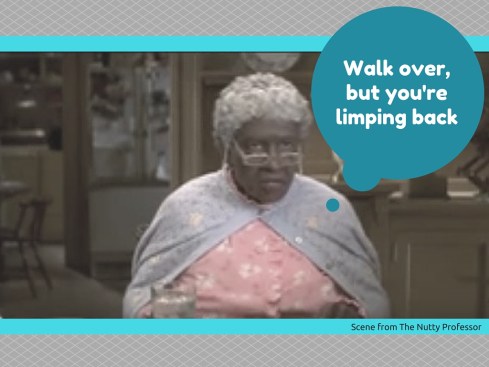
One of the funniest 3 minutes of cinema, in my humble opinion, is a dinner scene in The Nutty Professor, where the grandma of the family challenges her son, Cletus, to come around to her side of the table to settle an argument. She tells him with extreme confidence that “you walk over, but you’re limping back.”
It’s pretty scary, entering into a fight against an opponent you know you can’t beat. They will impose their will on you. They will defeat you. There’s no way to escape affliction. Cletus knew what his mom said was the truth. If he walked over, he’d be limping back!” He talked a good game, but in the end, he let that fear nail him to his seat. He was not about to get within arms reach of that feisty old lady.
I can identify with Cletus. With the fear he felt. It’s the same fear I felt when God was summoning me to engage with Him. To come around the table and wrestle with Him.
Jacob famously wrestled with God and forever walked with a limp afterward, a continual reminder of the wisdom he received during that encounter. No doubt, if you come around the table to wrestle with God, you will limp back. It’s a fact. I knew this was the truth. Like Cletus, I sat in my chair and refused to move closer to God. Not wanting to be afflicted with a limp.
This is where the comparison with Cletus ends. It was probably a smart move for him to stay seated. But when it’s God and not Grandma issuing the challenge, not answering the call is short sighted at best. The alternative, if we refuse to wrestle, is to be caged by sin. Paralyzed by fear, shame, guilt, resentment and a host of other negative emotions. Enslaved by our past, taken out by our wounds.
It’s okay to be afraid. But here’s what you have to do about it:
It is a fearful thing to fall into the hands of the living God…do not cast away your confidence…you have need of endurance, so that after you have done the will of God, you may receive the promise. – Hebrews 10: 31-36
It is an illusion to believe that we are walking just fine without God. If we try to just go along with our life, just push down the darkness, just shove those painful memories in a corner, just minimize and rationalize our behavior, just ignore the hurt, we in essence will be rendered unable to walk at all. Emotionally crippled. Paralyzed. Because we didn’t want to endure the pain of walking with a limp. Of engaging in our own work, dealing with our own stuff, and allowing God to touch us in a way that marks His purpose in our lives.
I currently walk with a very noticeable limp. I’ve had to face fears, insecurities, wounds, trauma, abuse and a rash of poor decisions and regrettable actions on my part. I have wrestled with God, continue to do so. And my flesh is losing the fight. That’s a good thing. It hurts. I’ll never walk the same when I’m done. But that’s a good thing. A really, really good thing. Sure beats not walking at all.
In the book Beloved, the main character, Sethe, wrestles with how she can prevail over the trauma of slavery while the memories are still alive and well. Many of us have this struggle. How do we overcome the past, when it still holds influence over us?
I’ve talked before about what many wise men and women have said and written…you don’t need to erase the past or block it out, or forget it. You need to embrace it, use it, and let it appropriately inform your future. Who we are is a direct result of where we’ve been and what we’ve experienced. Good. Bad. Ugly. Every mistake, every poor choice, every act of abuse or betrayal or trespass, it’s all been used to design you and equip you for your God-given purpose.
This means many of us need to closely examine how we treat the past, because we’ve likely made the mistake of letting memories (particularly bad ones) continue to derail us in our daily lives. To hold us down and oppress us. To define us. To strip hope, peace and joy from us. To poison our thoughts. To haunt our dreams.
We have to stop using our memory as a torture device, or a shaming technique, as evidence to substantiate the lies we tell ourselves, as an escape from reality, as an excuse for a pity party, as a cage that renders us helpless and depressed, as a way to keep score and justify our victim hood, or as a glass ceiling that limits our future potential.
Instead, we should leverage our memory positively to retain and recall the lessons we’ve learned, to keep us humble before God, to keep us filled with gratitude, as a means of instruction for others and ourselves, as a counter balance to irrational present thoughts or future tripping, as a detailed ledger of our strengths and our weaknesses, as a way to measure how far we’ve come and how far we still need to go.
Memories can be an extraordinarily powerful tool for our healing and our health. They can also be a cancer that gnaws at us from the inside and blinds us from all that is beautiful about ourselves, our lives and the world around us. Some things just go. They don’t hang around in our memory. Some things do. I strongly believe any memories that are strong enough to stay with us (good or bad or ugly) are to be used for a greater purpose. They have magical powers waiting to be harnessed. But like any superhero, we have to use that power for good and not in destructive ways.
Just a quick word of encouragement…regardless of how much trauma lives on in your memory…today you are blessed beyond measure. Air filling your lungs. Beauty filling your eyes. Music filling your ears. You can choose joy. You can leave the pain behind while you carry its scars. You can actually use the past to create more of the joy you seek now. It’s all about perspective. Trust me, it’s not easy. It’s a daily discipline. I’m not fully executing on it at the moment, which is why I needed to get it down in a blog post and place it in front of me. I needed a reminder today. Maybe you did too?

One of the things I’ve become acutely aware of in my spiritual journey is that I have to constantly question my motivations. Am I doing something good? Or am I doing something good, for me? In other words, is there a hidden agenda? I’ve deeply desired some things in my life, or produced certain accomplishments, which seemed very noble and holy. But these things were tainted, because at their core, they were just pitiful attempts to fuel my flesh and to feed my insecurities and need for affirmation. Most of us, if we are honest with ourselves, have been guilty of hiding unhealthy motivations under the guise of God-centered activities and accomplishments. Or is it just me?
There’s a great example of this in John 12:1-6. Martha is washing the feet of Jesus with an expensive oil. Judas complains and suggests it would have been better to sell the oil and give money to the poor.
At face value, it is easy to stop and think that maybe Judas had a point. You might even suggest he was being a noble man. But the passage goes on to explain that Judas wasn’t really being sincere. He didn’t care about the poor. He was a thief who frequently stole from the money box. He was using a seemingly God-centered gesture to quench a flesh-filled motivation.
For Judas, it was all about the money. After all, he eventually sold Jesus out for a small payday. Feeding his greed was the only way Judas knew to operate. For me, it’s been affirmation. That means I’ve been a performer all my life. An over-achiever. In the classroom. On the job. Whatever it was, I needed others to perceive that I was awesome at it. Otherwise, I had no peace. I’ve had success in my life. I’ve done some good things. In recent years, my marketing business actually helped a lot of worthy causes. But I did it all under the motivation of being affirmed. That was the hole in me. It wasn’t always a conscious decision. Judas obviously knew very well that he was scheming to steal from the money box when he suggested selling the oil to benefit the poor. In my life, the underlying motivation was usually much harder to detect, unless I went specifically searching for it.
Lately, I’ve done a lot of that. Searching out my true motivations. Weighing them. Separating the healthy from the unhealthy. It’s very sobering work. You start to realize how much of your life has been dedicated to filling holes and how truly disingenuous human beings can actually be.
This also causes me to pause when I’m feeling judgmental of others. As you know, it’s so much easier to psychoanalyze other people’s problems. It’s easier to see self-centered agendas and selfish motivations in someone else. In the past, I’ve been fairly swift to judge individuals when I get a whiff of them trying to trojan horse their way to what they really want or need.
But I’ve come to realize that most people are doing this without really realizing it. And regardless of whether they are aware of it or not, chances are they don’t fully understand how to control it, or have any idea where it’s coming from in the first place. That is unfortunate, because the most likely driver of their unhealthy motivations is an unresolved wound from their past that needs healing. Some experience that created trauma. A lie they have always believed. A betrayal that left them without faith in God or others, or maybe even themselves. Whatever it is, it left a hole. And holes beg to be filled. So, we silly humans try to fill them. We get very creative with this process, but it usually takes failure in our own clever actions to finally accept that God is the only way the hole can be filled, ultimately.
So, we act like Judas and set ourselves up the best ways we know how. Whatever it takes to get us through to the next fix. We get branded as hypocrites, either by ourselves or others or both. We lose our connection with authenticity. That’s not a very joyful way to live. Trust me.
I’ll leave you with this. The next time you are about to do something others would consider “good” or “admirable” or “valiant” or any other positive and affirming reaction, do a quick check of your heart to understand why you are doing it in the first place. Is there any underlying motivation that you need to bring to God and wrestle down to the ground? Marketing folks will tell you that to truly connect with a specific audience, you have to put yourself in their shoes and ask the question, “What’s in it for me?” Turn that question around, and pose it to yourself. Maybe a hidden agenda will arise out of your answer.
Secondly, the next time you are ready to lay down the hammer of judgment on someone else, stop and ask yourself what might be driving their actions? What is the source of their pain? What hole are they trying to fill? What is their hidden agenda? Or how about this one. What is it about their actions that has you so upset? Do you see something in them that reflects something about yourself that you really don’t like? You will have a much more empathetic and Christ-centered response to them, regardless of what they have done. And maybe you’ll be compelled to gently speak truth into their life, and yours, while discovering what’s hiding inside.
 We all have trauma and wounds. We all have disappointments, regrets, sorrows. We all have highly complicated ways our brains have been rewired by our actions and experiences. Yet, we always think everyone else has it all figured out, and that everyone else has it better. That we are the only one who has been left out and left behind. That no one else could possibly understand the unfortunate reality of our life.
I was reading a passage this morning in Acts, Chapter 2. It recounted what happened to the disciples after Jesus had appeared to them following his resurrection. He had promised they would receive power when the Holy Spirit came upon them. They were to wait patiently for that to happen.
In chapter two, it says that suddenly there came a sound from heaven that filled the entire house where they were sitting. Tongues of fire sat upon each of them. They were filled with the Holy Spirit and began speaking other languages. When the sound occurred, it drew the attention of the multitude, and people were amazed at what they saw and heard. “Aren’t all these men who speak in different tongues all Galileans?” they asked each other. “How is it that each of us hears in our own language? ”
Each of us have specific trials and specific afflictions that make us who we are. But even though our struggles are specific, they are not unique. Many others share your struggle, no matter what your struggle happens to be.
In this truth, you can find comfort and a calling.
You can find comfort in the fact that there are people who have walked the road you are on, no matter how dark, rocky and twisty it might be. There are people out there who get you, who understand what you’re going through, who know how your mind works and who speak your language. You just have to find them. That only requires a step of faith on your part to seek out support groups, raise your hand in church or just be bold and authentic with the people already in your life about what you need.
You can also find a calling. You were gifted by God, both your strengths and your weakness, your trophies and your trials. All is to be used for His glory. Because of your story, you have the remarkable ability to speak someone else’s language. Drugs. Divorce. Abuse. Arrest. Failure. Death. Depression. Sickness. Insecurity. Selfishness. Oh my, this is an endless list. The struggles you are enduring, or have overcome, equip you with a context, a vocabulary, an actual language that allows you to communicate with great effectiveness to others who share your struggle. There is nothing more powerful than that.
The people that day were amazed to see men who were speaking their language, despite their appearance and background suggesting that shouldn’t be possible. Trust me, there are people all around you that share your struggle. They might not look like it. They may appear to have their act together. You’d be surprised where the opportunity for comfort, or calling, can surface.
No matter where you are on your journey, seek out those who speak your language. Even if right now you need comfort and can’t see yourself responding to a calling. Just the act of helping you will be enormously helpful to the person who is comforting you. In any event, please do not sit in isolation with any struggle, big or small. Do not feel shamed by any sin. Do not tell yourself the lie that no one gets you or that no one could really understand. They can. And they don’t need a translator. They speak your language. And just as importantly, you speak theirs.
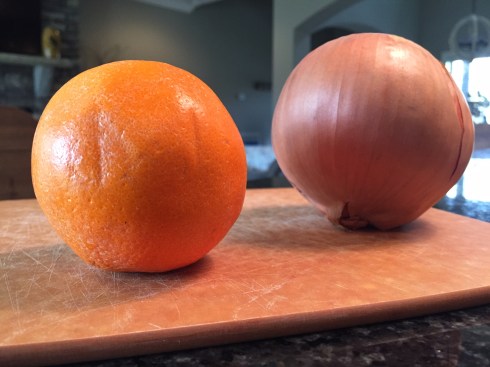
I have an incredibly important decision for you to make today. Are you going to be an orange, or an onion?
To be fair, you probably will need some context to appropriately answer this question. So, let’s start with a brief download on the relevant qualities of, and key differences between, oranges and onions.
An orange has a colorful, durable outer layer. Some find it extremely difficult to fully remove an orange’s peel, leaving some to even proclaim oranges are not worth the trouble it takes to eat one. Onions, on the other hand, have a very thin outer layer that doesn’t really preclude you from seeing what’s likely to be inside. It’s very thin, and peels off nice and easy, offering little resistance as you try to open it up.
Once inside, an orange is pretty straight forward. You’ve got your slices and some strings and a few seeds, maybe. Once you’ve broken through the exterior, you have a full view. Onions are a bit more complicated. You just keep peeling back layer, after layer, after layer. It seems you never get all the way to through an onion. It has so much more depth.
An orange tastes nice and sweet and refreshing. It offends only the most picky of people. It can easily be overpowered in smoothie mixes. While an onion, well, it is a force to be reckoned with. It can bring tears to your eyes, burning little daggers of tears. It has a smell and taste that is bold and not everyone is on board with it.
An orange doesn’t really do much for other foods. It sort of does its own thing. Sure it can have an impact on things such as water, but it’s not a food you would use to bring out the best in other foods. Onions are different. They pull flavor out of the foods they touch. They enhance the aroma and the taste of many dishes.
Spiritually speaking, we all have a choice to make. Are we going to be like the orange, or like the onion?
If you are an orange, you look something like this. You wear masks almost always. You have a tough outer shell that is hard to break through, and even if someone is able to penetrate it, all they will find is sugary sweetness. You’ve buried the rest so deep within yourself that it might as well be undetectable. You don’t offend. You don’t really stand for anything. You avoid conflict. And you don’t really have any kind of big impact on those around you. You just look for people who are content to sit in a bowl of fruit and look pretty, while hoping no one will want to squeeze you.
Meanwhile, the onions among us are very different. If you are an onion, your outer shell is transparent and thin, as if you are inviting people to see through and into you. The more someone gets to know you, the more layers they peel through and the more truth they see. You are a story with many chapters, and you don’t mind sharing every single one of them. You are powerful and bold, and way too honest for many people. You sometimes find that you have made someone uncomfortable because you refuse to be an orange like they are. On the other hand, you also positively impact many others and infuse their life with new hope and passion. You make them better, just because you share a small piece of yourself with them.
I’ve been an orange a lot longer than I’ve been an onion. And let me tell you. Being either is painful in this life. But only one has the potential to deliver you and to reveal God’s promises to you. I’ll let you guess which one that is.
*Writer’s note. Of course this metaphor is flawed, like most metaphors. Please don’t get hung up on any slight inaccuracies to the physical characteristics of onions and oranges. If you do, I commend you on your knowledge of round foods, but I am sad because you missed the entire point of this blog post. 🙂

Several weeks back, I spent a weekend with a group of men. All of us seeking deeper insight about ourselves, better understanding of God’s plan for our lives. During a break in the action, a few of us were walking the trails of the retreat center and stumbled upon a labyrinth. As we walked single file through the pattern, to the center and back out to the perimeter, we made small talk but mostly relaxed and decompressed from previous high-intensity conversations and group work. It was my first time in a labyrinth. To be honest, outside of Greek mythology, I had never really been exposed to the concept of a labyrinth. All I could remember is that I thought a labyrinth was where they kept the Minotaur. Didn’t sound like a great place to be.
In reality, a labyrinth can be a very peaceful place, full of meditation, focus and relaxation. A place of clarity. And within the pathway of the labyrinth that day, I realized something revolutionary.
I’ve always experienced my life as a very complicated maze. It was overwhelming, all the choices to be made, all the paths I could take. I felt confused and astray most of the time, reaching ahead clumsily with my limited sight, fearing what the next turn would present to me, fearful of a wrong turn or a dead end. I was lost. I thought I needed to solve the maze. I thought there must be a way out.
It turns out that life is less of a maze and more of a labyrinth. At least for those who believe in God as their higher power.
A maze is a complex puzzle that includes choices. It can have multiple entrances and exits and most importantly, dead ends. A labyrinth, by comparison, offers a single, non-branching path, which leads to the center and back out the same way. One entrance. One exit. One pathway.
In Psalm 16:11 it says, “You will show me the path of life.”
Notice that says, “THE” path. The world would tell you that every choice you make sets the path for your future. It’s a choose your adventure kind of life. But God says there is a plan for you. A highly specific plan that has been laid out before you. Sometimes we might be standing still, or walking backwards or feel lost or stuck, but if we step forward in faith, God will deliver us to the center and back again.
The entire book of Jeremiah is about surrendering to God’s will as the only way to escape calamity. There’s only one path. It twists, and it turns and sometimes it seems like you aren’t going anywhere. Sometimes you can almost see your destination, and then it feels like you are headed in the wrong direction, going farther away from where you thought you were being called. But if you persevere in the path God has provided, eventually you will enter into the promises He has made to all who call Him their Lord and Savior. He has ordered our steps. He has carefully crafted the journey He is asking us each to take. It’s not a maze. There aren’t dead ends. There might be pain, suffering, trials, tribulations. Bad decisions. Slow to no progress. But it will all be used to advance you to the ultimate end.
In Proverbs 3:5-7 it says, “Trust in the Lord with all your heart and lean not on your own understanding. In all your ways acknowledge Him and He shall direct your paths.”
Conversely, if we don’t place one foot in front of the other, believing we are walking within a labyrinth and not a maze, we will feel much differently about the situation.
In John 12:35 it says, “He who walks in darkness does not know where he is going.” Hosea 9:17 reaffirms this, suggesting that those who don’t trust in Lord’s plan for them will be “wanderers among the nations.”
When you trust that God is in control, the maze of life becomes manageable. You quickly begin to see that while the pattern is complicated, curvy and complex, it is indeed a path. If you are diligent and obedient, this path can lead only to one place. And you’ll be so glad you followed it. When we take things into our own hands, we can paralyze ourselves and convince ourselves that we are trapped in a maze and there’s no hope for escape. I spent way too much of my life convinced of that. I no longer waste energy or time worried about the next turn, because I know that the path I’m on leads me to God and His completely perfect will for my life.
I look back, and I can see how He used all the “wrong turns” and “dead ends” and “slow going” in incredibly powerful ways. Every time I returned my focus on Him, I moved closer to the center, no matter how far I had strayed or how long I had tarried. Life is not a maze. It is a labyrinth. The path you are on is ordained by God. Train your eyes on Him, take the next step forward and soon enough you will see what I have seen. I promise you’ll never be the same.
 So, since I just restarted blogging here, I decided to comb back through the archives and revisit some of my earlier posts. At first, I thought to myself, “Well, that’s not half bad” and “Hey, I like that one.” And then as I kept reading, and became less self involved (i.e. admiring my own writing), I realized something. I was a fraud. For several years of writing blog posts here, talking about the way God was moving in my life. A friggin fraud.
It’s not that I was lying. God was trying to do all the things I talked about. He was sharing the insights with me. Showing me the way. I just wasn’t moving. Not really. You see, I had intellectualized the call of God. I just hadn’t internalized it. I was processing it with my head, but not passing it along to my heart. I heard the call. I just wasn’t really answering it.
It was easy to share about the magical ways God was stepping into my life. What I didn’t share was how I was not able, capable or willing to do what He asked, what He really needed me to do. Because of that, I pretended and pontificated. Without conviction. Real action. True transformation. I was full of hot air, but my heart was frozen solid.
I eventually got tired of acting like I was working God’s plan, so I quit blogging. I quit praying. I quit seeking. I drifted. Fell off the wagon and was run over by it. And in the darkness, there was no light to be seen, no God to be heard, no path to follow.
And yet, God pursued me. And a world of heartache later, I’m back in that place. He brought me all the way back to where He had me years before. Face to face with what He really wants me to do. I don’t like how I feel when I read those old blog posts. I can’t stomach the person who wrote them, that person who was taking God’s wisdom and tossing it around with wordplay, refusing to apply any of it to his own life. What a fraud! What a phony! What a counterfeit Christian I was.
So now it’s time to live in the truth and walk in the light. Live authentically. Love my God. Love myself. Love my family. Love people. None of which I was doing with any degree of success before. I’m ready, willing and excited to change that.
I was having breakfast with a friend this morning. We talked a lot about baseball, raising kids, life. Eventually, we had to make it around to the awkward topic of my journey, the war that I’m currently waging, as I fight my way closer to being the man God designed me to be. As we were chatting, my friend posed a thoughtful question to me. Likely intending it to be hypothetical.
“Why is it that we have to be broken to be used by God?”
I didn’t even hesitate in responding. Because I know. If we have any other path, any other hope, any other semblance of a plan that we think will work, we won’t rest in God. We won’t trust Him. We will do it our way. Before I could help myself, I wandered into a lengthy analogy, which I would like to share here. I think it explains fairly well why we must be broken before God can actually work with us.
Say you have a car. And let’s say that car has lots of things wrong with it. Dents along the bumpers. A door that won’t open from the outside. A busted headlight. Screeching brakes. A cracked windshield. Despite all these defects, these imperfections, we can still drive the car. And many of us do. It’s not running perfectly, but if we’re trying to avoid the expense or the inconvenience of having it professionally repaired, we can limp along with it for months or years.
 It’s not until the transmission falls out of the bottom of it that we actually get help. It’s not until we are on the side of the road, broken down, with literally no other option than to call the mechanic and beg for his divine intervention.
It’s the same with God. We will walk, limp, crawl, drag ourselves forward. It’s not until we are broken, desperate and left on the roadside of life that most of us turn our eyes to God and say, “Ok, have thy will and thy way with me.”
That’s me. I was driving a wreck of a life. The headlights were out, the brakes were shot, my tires worn down to the wires. I was driving in the pitch black into oncoming traffic, not knowing where I was even trying to go. It was storming, and I had no windshield wipers. The winds were blowing, and I had no power steering. And yet, I just kept pushing the gas. Gripping the wheel. Driving.
It wasn’t until I hit the wall, or whatever it was, that I finally stopped. When I couldn’t go further. When it was literally impossible for me to do this on my own. The mechanic showed up. Answered my prayer. And began to restore me so I could fly down the road like a finely tuned machine on the way to a far better place.
I’m broken. But I’m beautifully made. And finally, I get to find out what that feels like, and what God wants to do with me. Amen!
 the way to (t)here
What You Said